Industry News · Mobile statistics
App Store Statistics 2026: Ecosystem Size, Apps, Developers, Fraud and Commission
The App Store ecosystem facilitated about $1.4 trillion in billings and sales in 2025, and Apple reports more than 850 million weekly visitors across 175 storefronts. It listed 1,961,596 apps and 51.8 million registered developers in 2024. Apple stopped over $2.2 billion of fraudulent transactions in 2025.
Key takeaways
- The App Store ecosystem facilitated $1,437 billion in billings and sales in 2025, almost triple 2019, but 79% of it is physical goods and services (shopping, travel, food delivery) on which Apple takes no commission.
- Digital goods and services, the part Apple’s commission applies to, came to $149 billion in 2025; Apple says developers paid no commission on more than 90% of the ecosystem total.
- The App Store had 1,961,596 apps and 51,766,243 registered developers in 2024, with an average of 813 million weekly visitors, rising to more than 850 million in 2025.
- Apple reviewed more than 9.1 million app submissions in 2025, up from 6.1 million in 2022, and rejected more than 2 million of them.
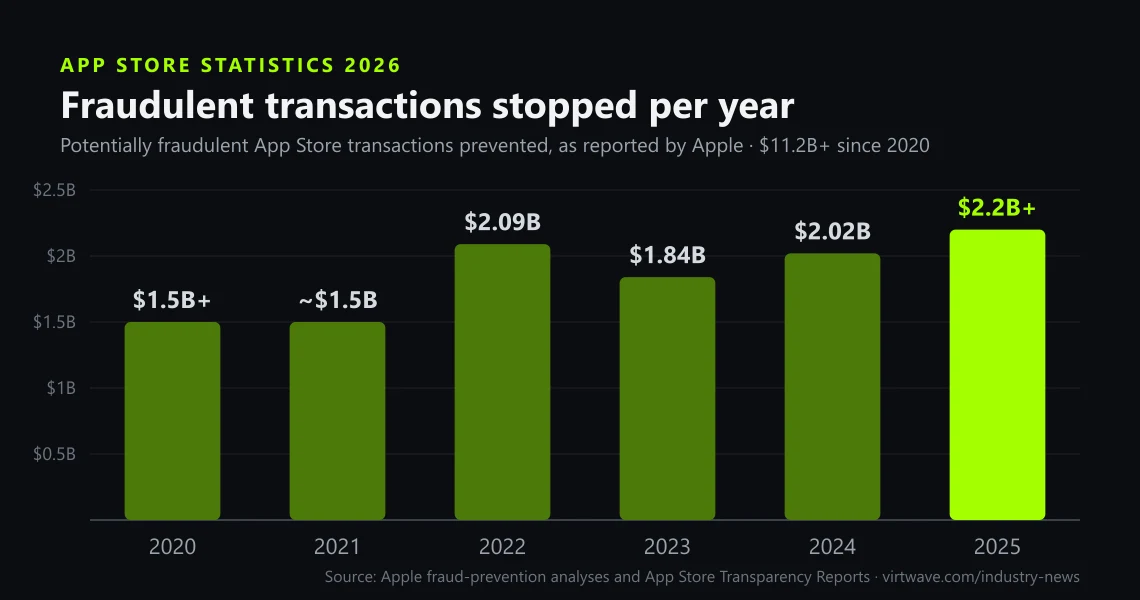
- Apple says it stopped more than $2.2 billion of potentially fraudulent transactions in 2025 and more than $11.2 billion over six years, and blocked 5.4 million stolen cards.
- Apple’s Services segment, which counts only Apple’s commission on third-party apps, earned $109.2 billion in fiscal 2025 (26% of Apple’s sales) at a 75.4% gross margin, while court orders in the US and the DMA in the EU are cutting into the commission model.
Key figures
$1.4 trillion
billings and sales facilitated by the App Store ecosystem worldwide in 2025, a record
$1,437 billion in the study’s table, up from $1.3 trillion in 2024. It includes physical goods bought in apps and in-app advertising, not only App Store purchases.
850 million+
average weekly visitors to the App Store, according to Apple
Up from 813 million a week in 2024, 735 million in 2023, 657 million in 2022 and “half a billion” in 2020.
1,961,596
apps on the App Store in 2024
Up from 1,870,119 in 2023 and 1,783,232 in 2022. Apple has not yet published its 2025 Transparency Report.
51.8 million
registered Apple developers in 2024
51,766,243 exactly, up from 42,219,169 in 2023 and 36,974,015 in 2022. Registered accounts, not developers who publish apps.
$2.2 billion+
potentially fraudulent App Store transactions Apple says it stopped in 2025
Up from over $2 billion in 2024 ($2,023,389,488 in the Transparency Report). These are blocked attempts, not losses.
$149 billion
billings and sales of digital goods and services in iOS apps in 2025, about 10% of the ecosystem
Games, enterprise apps and video streaming were the largest categories. Not the same as App Store billings: it includes digital purchases made elsewhere but used in iOS apps. It was $131 billion in 2024.
$109.2 billion
Apple Services net sales in fiscal 2025 (year to 27 September 2025), up 13.5%
$109,158 million vs $96,169 million. Services includes the App Store, advertising, cloud, payments and Apple’s subscriptions; Apple does not report App Store revenue separately.
15%
commission for App Store Small Business Program members earning up to $1 million a year
Launched 1 January 2021. Subscriptions after a subscriber’s first year and Video Partner Program sales also pay 15% (developers keep 85%).
How big is the App Store economy?
Apple’s headline number is not App Store revenue. It is everything apps on iPhone and iPad helped people buy: digital purchases, physical goods and services ordered in apps, and in-app advertising. By that measure the ecosystem reached $1.4 trillion in 2025, according to a study by Analysis Group economists supported by Apple.[7][8]
$1.4 trillion
billings and sales facilitated by the App Store ecosystem worldwide in 2025, a record
$1,437 billion in the study’s table, up from $1.3 trillion in 2024. It includes physical goods bought in apps and in-app advertising, not only App Store purchases.
$149 billion
billings and sales of digital goods and services in iOS apps in 2025, about 10% of the ecosystem
Games, enterprise apps and video streaming were the largest categories. Not the same as App Store billings: it includes digital purchases made elsewhere but used in iOS apps. It was $131 billion in 2024.
$1.1 trillion
sales of physical goods and services through iOS apps in 2025, about 79% of the ecosystem
$1,137 billion: general retail $673 billion, travel $165 billion, food delivery and pickup $120 billion, grocery $98 billion, ride hailing $64 billion. Apple takes no commission on these sales.
$151 billion
in-app advertising revenue from ads developers placed in their iOS apps in 2025
Up from $150 billion in 2024. Excludes ad-network revenue, mobile web and search ads.
More than 90%
share of App Store ecosystem billings and sales on which developers paid no commission to Apple
Apple has repeated this figure in every study since 2022 (it said more than 85% for 2019).
+180%
growth of the App Store ecosystem from 2019 to 2025, from $513 billion to $1,437 billion
Uses the study’s restated 2019 figure of $513 billion (first published as $519 billion). Digital goods +141%, physical goods +185%, in-app advertising +186%.
40+ of the top 100
top 100 App Store apps in 2025 that had consumer-facing AI features
Apple says those apps saw stronger billing growth than the other top 100 apps; it did not publish the growth rates.
App Store ecosystem billings and sales, by study year
Source: Apple Newsroom — Apple’s App Store ecosystem facilitated over half a trillion dollars in commerce in 2019 (June 2020); Apple Newsroom — Apple developers grow App Store ecosystem billings and sales by 24 percent in 2020 (June 2021); Apple Newsroom — Developers generated $1.1 trillion in the App Store ecosystem in 2022 (May 2023); Apple Newsroom — Global App Store helps developers reach new heights, supporting $1.3 trillion in billings and sales in 2024 (June 2025); Analysis Group (for Apple) — Apple’s Global App Store Ecosystem and Its Growth, 2025 (PDF, June 2026)
What the number does not say: about 79% of the 2025 total is physical goods and services, such as retail orders, travel bookings and food delivery, which would mostly happen anyway on the web. The part that resembles “App Store sales” is the $149 billion of digital goods and services, and even that includes purchases made outside the App Store. Apple does not publish its own App Store billings.[8]
$406 billion
App Store ecosystem billings and sales in the US in 2024, per a separate US study
Up from $142 billion in 2019. The US study also found small US developers’ earnings rose 76% from 2021 to 2024. Its method differs from the global study, so it is not directly comparable with the $453 billion for 2025.
$320 billion+
earned by iOS developers on the App Store from 2008 to 2022
The last cumulative developer-earnings figure Apple published; it has not given an updated total since.
+71%
revenue growth of small App Store developers worldwide from 2020 to 2022 (+87% in the US)
Small developers are defined as earning up to $1 million a year with fewer than 1 million downloads; they are more than 90% of App Store developers.
App Store ecosystem by region
$562 billion
App Store ecosystem billings and sales in Greater China in 2025, the largest region
General retail alone was $363 billion, 65% of China’s total. Digital goods were $21 billion.
$453 billion
App Store ecosystem billings and sales in the United States in 2025
General retail was 37% of the US total; digital goods $62 billion and in-app advertising $71 billion, both the largest of any region.
$184 billion
App Store ecosystem billings and sales in Europe in 2025
Western, Central and Eastern Europe including the UK, excluding Russia. Japan was $52 billion.
$61.1 billion
App Store ecosystem billings and sales in the UK in 2025, the largest European country
Ahead of Germany ($27.0 billion), France ($14.0 billion), Italy ($6.8 billion) and Spain ($6.6 billion); the study credits the UK’s higher iOS market share.
| Region | Digital goods and services | Physical goods and services | In-app advertising | Total |
|---|---|---|---|---|
| Greater China | $21B | $511B | $29B | $562B |
| United States | $62B | $320B | $71B | $453B |
| Europe | $24B | $135B | $25B | $184B |
| Japan | $15B | $31B | $6B | $52B |
| World | $149B | $1,137B | $151B | $1,437B |
Totals may not sum due to rounding. Europe includes the UK and the Nordic region but not Russia.
China is the largest region only because of shopping: general retail there was $363 billion, 65% of the Chinese total. On digital goods and in-app advertising, the US is the biggest market by far, and Japan stands out with digital goods at 28% of its total, against about 15% in the US and Europe. Since 2019 the ecosystem has more than doubled in China and more than tripled in the US and Europe, Apple says.[8][7]
How many apps, developers and visitors does the App Store have?
850 million+
average weekly visitors to the App Store, according to Apple
Up from 813 million a week in 2024, 735 million in 2023, 657 million in 2022 and “half a billion” in 2020.
175
countries and regions with an App Store storefront
Unchanged since at least 2020. Apple handles tax in nearly 200 regions and supports more than 40 local currencies.
1,961,596
apps on the App Store in 2024
Up from 1,870,119 in 2023 and 1,783,232 in 2022. Apple has not yet published its 2025 Transparency Report.
51.8 million
registered Apple developers in 2024
51,766,243 exactly, up from 42,219,169 in 2023 and 36,974,015 in 2022. Registered accounts, not developers who publish apps.
839 million
average weekly app downloads from the App Store in 2024
839,266,915 a week, up from 787,999,950 in 2023; there were also 1.9 billion weekly redownloads.
441 million
average weekly number of customer accounts searching the App Store in 2024
440,896,463 a week. Only 169,235 apps a week appeared in the top 10 results of at least 1,000 searches.
370 billion+
app downloads by iOS users from 2008 to 2022
The last cumulative download figure Apple published.
17
apps and games honoured in the 2025 App Store Awards
iPhone App of the Year went to Tiimo and iPhone Game of the Year to Pokémon TCG Pocket; six of the 17 were Cultural Impact winners.
Average weekly App Store visitors
Source: Apple — 2022 App Store Transparency Report (PDF); Apple — 2023 App Store Transparency Report (PDF); Apple — 2024 App Store Transparency Report (PDF); Apple Newsroom — The App Store stopped over $2.2 billion in fraudulent transactions in 2025
| Measure | 2022 | 2023 | 2024 |
|---|---|---|---|
| Apps on the App Store | 1,783,232 | 1,870,119 | 1,961,596 |
| Registered Apple developers | 36,974,015 | 42,219,169 | 51,766,243 |
| Average weekly visitors | 656,739,889 | 734,673,588 | 813,110,348 |
| Average weekly app downloads | 747,873,877 | 787,999,950 | 839,266,915 |
| Fraudulent transactions prevented | $2,090,195,480 | $1,838,127,451 | $2,023,389,488 |
The 2025 report had not been published on 18 October 2026.
Source: Apple — 2022 App Store Transparency Report (PDF); Apple — 2023 App Store Transparency Report (PDF); Apple — 2024 App Store Transparency Report (PDF)
The app count grows slowly, about 5% a year, because Apple removes outdated and abandoned apps as fast as new ones arrive. Registered developers jumped 23% in 2024, but a registered developer is anyone with a developer account, not someone who has shipped an app; Apple says more than 220,000 developers published their first app that year.[17][16][15][2]
App Review: submissions, rejections and removals
9.1 million+
app submissions evaluated by Apple’s App Review team in 2025
Up from 7.7 million in 2024, 6.9 million in 2023 and 6.1 million in 2022. Apple links the jump to AI development tools driving more submissions.
2 million+
app submissions rejected in 2025 for breaking the App Review Guidelines
Over 1.2 million new apps and nearly 800,000 app updates; about 22% of submissions. Many rejected apps are fixed and approved later.
306,000+
new developers App Review helped onto the App Store in 2025
Up from more than 220,000 developers who published their first app in 2024.
443,000+
app submissions rejected for privacy violations in 2025
Plus over 371,000 rejected as copies, spam or misleading and over 22,000 for hidden or undocumented features.
Nearly 59,000
apps removed in 2025 for “bait-and-switch” changes made after App Review
For example apps approved as puzzles or calculators that later turned into financial-fraud tools. The count was over 17,000 in 2024.
82,509
apps removed from the App Store in 2024
Utilities (16,191) and games (15,122) were the categories with most removals; 26,224 removals were appealed.
1,730
apps removed after government takedown demands in 2024
1,307 of them in mainland China, then Russia (171) and South Korea (79). Apps are removed only in the country making the demand.
| Year | Submissions reviewed | Submissions rejected | New developers helped onto the store |
|---|---|---|---|
| 2020 | Not stated | Nearly 1M new apps + nearly 1M updates | 180,000+ |
| 2021 | Not stated | 835,000+ new apps + 805,000 updates | 107,000+ |
| 2022 | 6.1M+ | Nearly 1.7M | 185,000+ |
| 2023 | Nearly 6.9M | 1.7M+ | 192,000+ |
| 2024 | 7.7M+ | 1.9M+ | 220,000+ |
| 2025 | 9.1M+ | 2M+ | 306,000+ |
Source: Apple Newsroom — App Store stopped more than $1.5 billion in potentially fraudulent transactions in 2020 (May 2021); Apple Newsroom — App Store stopped nearly $1.5 billion in fraudulent transactions in 2021 (June 2022); Apple Newsroom — App Store stopped more than $2 billion in fraudulent transactions in 2022 (May 2023); Apple Newsroom — App Store stopped over $7 billion in potentially fraudulent transactions (May 2024); Apple Newsroom — The App Store prevented more than $9 billion in fraudulent transactions (May 2025); Apple Newsroom — The App Store stopped over $2.2 billion in fraudulent transactions in 2025
Submissions rose by half between 2022 and 2025, and Apple ties the latest jump to AI coding tools making apps easier to build. The rejection rate has stayed between about 22% and 28%. Most rejections are routine (bugs, incomplete apps, missing information) rather than fraud, and many rejected apps are fixed and approved; in 2024, 295,109 submissions were approved after an earlier rejection.[1][15]
App Store fraud: how much does Apple stop?
$2.2 billion+
potentially fraudulent App Store transactions Apple says it stopped in 2025
Up from over $2 billion in 2024 ($2,023,389,488 in the Transparency Report). These are blocked attempts, not losses.
$11.2 billion+
potentially fraudulent transactions stopped from 2020 to 2025
Apple’s own running total across its six annual fraud analyses.
5.4 million+
stolen credit cards blocked from App Store purchases in 2025
Up from 4.7 million in 2024 and 3 million in 2020. Nearly 2 million accounts were also banned from transacting.
1.1 billion
fraudulent customer account creations rejected in 2025
Up from over 711 million in 2024. Apple also deactivated 40.4 million existing customer accounts for fraud and abuse.
193,000
developer accounts terminated over fraud concerns in 2025
Apple also rejected more than 138,000 developer enrollments. Terminations peaked at over 802,000 in 2021.
Nearly 195 million
fraudulent ratings and reviews blocked in 2025, out of more than 1.3 billion processed
Roughly one in seven. Apple also kept about 7,800 deceptive apps out of search results and 11,500 off the charts.
680,000+
apps that use Apple’s payment technologies (Apple Pay or StoreKit) to sell goods and services
Apple gave 420,000 for 2024 and nearly 1 million for 2023, so the series is not consistent from year to year.
Potentially fraudulent App Store transactions stopped, by year
Source: Apple Newsroom — App Store stopped more than $1.5 billion in potentially fraudulent transactions in 2020 (May 2021); Apple Newsroom — App Store stopped nearly $1.5 billion in fraudulent transactions in 2021 (June 2022); Apple Newsroom — App Store stopped more than $2 billion in fraudulent transactions in 2022 (May 2023); Apple — 2023 App Store Transparency Report (PDF); Apple — 2024 App Store Transparency Report (PDF); Apple Newsroom — The App Store stopped over $2.2 billion in fraudulent transactions in 2025
Developer accounts terminated for fraud, by year
Source: Apple Newsroom — App Store stopped more than $1.5 billion in potentially fraudulent transactions in 2020 (May 2021); Apple Newsroom — App Store stopped nearly $1.5 billion in fraudulent transactions in 2021 (June 2022); Apple Newsroom — App Store stopped more than $2 billion in fraudulent transactions in 2022 (May 2023); Apple Newsroom — App Store stopped over $7 billion in potentially fraudulent transactions (May 2024); Apple Newsroom — The App Store prevented more than $9 billion in fraudulent transactions (May 2025); Apple Newsroom — The App Store stopped over $2.2 billion in fraudulent transactions in 2025
These are Apple’s own counts of blocked attempts. They measure enforcement, not the amount of fraud that got through, and Apple does not say how it values a blocked transaction. A rise can mean more fraud or better detection. For what scams cost consumers who pay with gift cards, including Apple gift cards, see the FTC data in our gift card scam statistics report.[1]
- Stolen cards blocked: more than 3 million (2020), 3.3 million (2021), nearly 3.9 million (2022), 3.5 million (2023), nearly 4.7 million (2024), more than 5.4 million (2025).
- Fraudulent ratings and reviews removed or blocked: more than 147 million (2022), nearly 152 million (2023), more than 143 million (2024), close to 195 million (2025).
- Apps from pirate storefronts blocked: nearly 57,000 (2022), more than 47,000 (2023), over 10,000 (2024), 28,000 (2025).
App Store commission and fees
30%
standard App Store commission on paid apps and in-app purchases of digital goods
Applies to developers earning more than $1 million a year in proceeds; first-year subscriptions also pay 30% (developers keep 70%).
15%
commission for App Store Small Business Program members earning up to $1 million a year
Launched 1 January 2021. Subscriptions after a subscriber’s first year and Video Partner Program sales also pay 15% (developers keep 85%).
$99 a year
Apple Developer Program membership fee
The Apple Developer Enterprise Program, for internal apps only, costs $299 a year.
26%
App Store commission on Apple In-App Purchase sales in the EU from 1 October 2026
15% for small businesses and subscriptions after year one; 20% (or 10%) when the developer uses its own payment processing in the app.
5%
Core Technology Commission on digital sales in EU apps distributed outside the App Store
Replaced the €0.50-per-install Core Technology Fee introduced in 2024; the Initial Acquisition Fee and Store Services Fee were also dropped.
900
price points available to App Store developers, from $0.29 up to $10,000 on request
Introduced from December 2022, nearly ten times the earlier choice, across 175 storefronts.
| Case | Outside the EU | EU (from 1 Oct 2026) |
|---|---|---|
| Standard, Apple In-App Purchase | 30% | 26% |
| Small Business Program (up to $1M proceeds) | 15% | 15% |
| Subscriptions after the first year | 15% | 15% |
| Video Partner Program | 15% | 15% |
| Developer’s own payment processing in the app | Not generally allowed (some local exceptions) | 20% (10% for small businesses and year-two subscriptions) |
| Link-out to a website offer (sales within 7 days) | US: no commission under court order | 15% (10%) |
| Apps distributed outside the App Store | Not available in most countries | 5% Core Technology Commission |
Physical goods and services, and purchases made outside apps, carry no commission anywhere. The US link-out position follows the April 2025 injunction and may change after the Supreme Court case.
Source: Apple Newsroom — Apple announces App Store Small Business Program (November 2020); Apple Developer — App Store Small Business Program; Apple Developer — Auto-renewable Subscriptions; Apple Developer — Apple Video Partner Program; Apple Developer — Update on apps distributed in the European Union; Apple (SEC EDGAR) — Apple Form 10-Q for the quarter ended 27 June 2026 (filed 31 July 2026)
The 30% rate that gives the App Store its reputation now applies to a narrowing slice of sales: only developers above $1 million a year, on first-year subscriptions and one-off purchases, outside the EU and outside US link-outs. Apple has rewritten its EU terms more than once since March 2024; the version in force since 1 October 2026 drops the per-install €0.50 Core Technology Fee for a 5% commission.[19][23][24]
Court rulings and regulators
€500 million
fine the European Commission imposed on Apple on 23 April 2025 over App Store anti-steering rules
Under DMA Article 5(4); Apple has appealed. A second investigation could bring fines up to 10% of worldwide net sales.
30 June 2026
date the US Supreme Court agreed to review part of the Epic Games injunction against Apple
Since April 2025 a US court has barred Apple from charging any commission on purchases made outside apps; the Ninth Circuit said in December 2025 that some commission may be allowed.
- March 2024: Apple’s first DMA terms take effect in the EU (10% or 17% commission, 3% payment processing, €0.50 Core Technology Fee per first annual install above 1 million).
- 23 April 2025: the European Commission fines Apple €500 million over anti-steering rules; Apple appeals.
- 30 April 2025: a US district court bars Apple from charging any commission on purchases consumers make outside an app.
- 11 December 2025: the Ninth Circuit upholds most of that order but says Apple may charge some commission on link-out purchases.
- 30 June 2026: the US Supreme Court agrees to review the civil-contempt standard in the case.
- 1 October 2026: Apple’s unified EU business terms take effect.
Apple Services revenue
$109.2 billion
Apple Services net sales in fiscal 2025 (year to 27 September 2025), up 13.5%
$109,158 million vs $96,169 million. Services includes the App Store, advertising, cloud, payments and Apple’s subscriptions; Apple does not report App Store revenue separately.
26.2%
share of Apple’s total net sales that came from Services in fiscal 2025
Our ratio: $109,158 million of $416,161 million.
75.4%
gross margin of Apple’s Services in fiscal 2025, against 36.8% for products
Up from 70.8% in fiscal 2023. App Store sales of third-party apps are booked net, so only Apple’s commission is counted as revenue.
$30.7 billion
Apple Services net sales in the quarter to 27 June 2026, up 12%
$91.7 billion in the first nine months of fiscal 2026 (+14%). Apple credited advertising and cloud for the quarter’s growth, without naming the App Store.
Apple Services net sales by fiscal year
Source: Apple (SEC EDGAR) — Apple Form 10-K for the fiscal year ended 25 September 2021; Apple (SEC EDGAR) — Apple Form 10-K for the fiscal year ended 30 September 2023; Apple (SEC EDGAR) — Apple Form 10-K for the fiscal year ended 27 September 2025
Services has more than doubled since fiscal 2019 (2.4×) and its gross margin is roughly double that of iPhone, Mac and other products. Apple named the App Store among the drivers of Services growth in fiscal 2021 and fiscal 2025, but for the June 2026 quarter it named only advertising and cloud services. Because App Store sales of third-party apps are booked net, the App Store’s contribution is Apple’s commission, not what customers spend.[29][27][30]
Methodology and caveats
We read every figure on 18 October 2026 from Apple’s own publications: Newsroom releases, App Store Transparency Reports, Apple Developer pages and Apple’s 10-K and 10-Q filings on SEC EDGAR. Nothing was taken from other statistics sites.
Annual series (fraud prevented, App Review counts, developer terminations) come from Apple’s yearly fraud-prevention releases, published each May or June about the previous calendar year. Where the Transparency Report gives an exact value for the same year, we use it.
Ecosystem figures come from studies by Analysis Group economists, supported by Apple. We give each year as first published, and say where a later study restated it.
Apple Services figures are fiscal years ending on the last Saturday of September. Percentages and ratios marked “our ratio” are our own arithmetic on the reported numbers.
Commission rates are as published on Apple Developer pages on 18 October 2026. They exclude taxes and apply only to digital goods and services.
- Almost every figure here is Apple reporting on itself. Fraud prevented, weekly visitors and the ecosystem size are not independently audited.
- The ecosystem study measures economic activity apps help with, mostly physical purchases. It is not App Store revenue, Apple’s revenue, or developer earnings. Its estimates rest on third-party data (EMARKETER and others) and are revised every year.
- Fraud figures count blocked attempts and how Apple valued them. They do not show how much fraud succeeded or what users lost.
- Registered developers count accounts, not active publishers, and the app count is a point-in-time total that rises and falls with clean-ups.
- Apple does not disclose App Store revenue, billings or paid-user numbers. Services revenue covers much more than the App Store.
- Commission rules differ by country (EU, US link-outs, and special rules in places such as Japan and South Korea that are not covered here) and are being changed by courts and regulators.
How we research and correct our content is set out in our editorial policy.
App Store Statistics 2026: FAQ
How many apps are on the App Store?
There were 1,961,596 apps on the App Store in 2024, according to Apple’s 2024 App Store Transparency Report, up from 1,870,119 in 2023 and 1,783,232 in 2022. Apple had not published a 2025 figure by October 2026.
How many people use the App Store?
Apple says the App Store gets more than 850 million weekly visitors across 175 countries and regions (2025). The 2024 Transparency Report gives an exact weekly average of 813,110,348 visitors and 839 million app downloads a week.
How much money does the App Store make?
Apple does not report App Store revenue. Its whole Services segment, which includes the App Store commission, earned $109.2 billion in fiscal 2025. The wider App Store ecosystem facilitated $1.4 trillion in billings and sales in 2025, but $1.1 trillion of that was physical goods and services on which Apple takes no commission.
What is the App Store commission?
Outside the EU, Apple takes 30% of paid apps and in-app purchases of digital goods, and 15% for Small Business Program members earning up to $1 million a year and for subscriptions after their first year. In the EU, from 1 October 2026, the rate is 26%, or 15% for small businesses.
How many developers are on the App Store?
Apple’s 2024 Transparency Report counts 51,766,243 registered Apple developers, up from 42.2 million in 2023. Far fewer publish apps: about 306,000 new developers got onto the App Store in 2025, according to Apple.
How much fraud does the App Store stop?
Apple says it stopped more than $2.2 billion in potentially fraudulent transactions in 2025 and more than $11.2 billion from 2020 to 2025. In 2025 it also blocked 5.4 million stolen credit cards, rejected 1.1 billion fraudulent account creations and terminated 193,000 developer accounts.
How many apps does Apple reject?
Apple’s App Review team evaluated more than 9.1 million app submissions in 2025 and rejected more than 2 million, including over 1.2 million new apps and nearly 800,000 updates. Over 443,000 were rejected for privacy violations.
How much is the Apple Developer Program?
Membership of the Apple Developer Program costs $99 a year, which is required to publish on the App Store. The Apple Developer Enterprise Program, for internal company apps, costs $299 a year.
Cite or reuse these statistics
Every figure in this report is free to reuse in articles, videos, research and AI-written content under CC BY 4.0. The one condition: credit Virtwave with a link to this page, so your readers can check the number and see when it was last updated.
https://www.virtwave.com/industry-news/app-store-statistics<a href="https://www.virtwave.com/industry-news/app-store-statistics">App Store Statistics 2026 (Virtwave)</a>Haddad, N. (2026). App Store Statistics 2026. Virtwave. https://www.virtwave.com/industry-news/app-store-statisticsSources
- Apple NewsroomFirst-partyThe App Store stopped over $2.2 billion in fraudulent transactions in 2025Accessed — $2.2B+ in 2025, $11.2B+ over six years; 850M+ weekly visitors, 175 storefronts; 9.1M+ submissions, 2M+ rejected; 306,000+ new developers; 193,000 developer accounts terminated; 1.1B fake account creations; 5.4M+ stolen cards; 195M fraudulent reviews; 680,000+ apps use Apple payments.
- Apple NewsroomFirst-partyThe App Store prevented more than $9 billion in fraudulent transactions (May 2025)Accessed — 2024: $2B+; 813M weekly visitors; 7.7M+ submissions, 1.9M+ rejected; 220,000+ first-time publishers; 146,000+ developer accounts terminated; 711M+ account creations rejected; 4.7M stolen cards; 17,000+ bait-and-switch removals.
- Apple NewsroomFirst-partyApp Store stopped over $7 billion in potentially fraudulent transactions (May 2024)Accessed — 2023: $1.8B+; nearly 6.9M submissions, 1.7M+ rejected; close to 118,000 developer accounts terminated; 3.5M+ stolen cards; nearly 1 million apps use Apple Pay and StoreKit.
- Apple NewsroomFirst-partyApp Store stopped more than $2 billion in fraudulent transactions in 2022 (May 2023)Accessed — 2022: $2.09B; 6.1M+ submissions, nearly 1.7M rejected; 428,000 developer accounts terminated; nearly 3.9M stolen cards; 147M+ reviews blocked; 650M+ weekly visitors.
- Apple NewsroomFirst-partyApp Store stopped nearly $1.5 billion in fraudulent transactions in 2021 (June 2022)Accessed — 2021: nearly $1.5B; 802,000+ developer accounts terminated; 3.3M+ stolen cards; 835,000+ new apps and 805,000 updates rejected; 107,000+ new developers.
- Apple NewsroomFirst-partyApp Store stopped more than $1.5 billion in potentially fraudulent transactions in 2020 (May 2021)Accessed — Apple’s first fraud analysis. 2020: $1.5B+; 470,000 developer accounts terminated; 3M+ stolen cards; 180,000+ new developers; 1.8 million apps on the store.
- Apple NewsroomFirst-partyApp Store ecosystem reaches record $1.4 trillion as developers continue to thrive globally (June 2026)Accessed — $1.4T+ in 2025; digital $149B, physical $1.1T, ads $151B; >90% without commission; 850M+ average weekly users; 40+ of the top 100 apps with consumer AI features.
- Analysis Group (for Apple)Apple’s Global App Store Ecosystem and Its Growth, 2025 (PDF, June 2026)Accessed — By Jessica Burley, Juliette Caminade and Markus von Wartburg; “Support for this study was provided by Apple.” Table 1 (world $1,437B), Table 2 (changes since 2019), Table 3 (regions), Table 4 (UK, Germany, France, Italy, Spain). Restates 2019 as $513B.
- Apple NewsroomFirst-partyGlobal App Store helps developers reach new heights, supporting $1.3 trillion in billings and sales in 2024 (June 2025)Accessed — $1.3T in 2024; digital $131B; physical >$1T; ads $150B; 813M+ weekly visitors; 40+ currencies, tax handling in nearly 200 regions.
- Apple NewsroomFirst-partyApp Store in the U.S. facilitated over $400 billion in developer billings and sales in 2024 (May 2025)Accessed — US $406B in 2024 (2019: $142B); physical $277B, ads $75B, digital $53B; small developers’ earnings +76% 2021–2024.
- Apple NewsroomFirst-partyDevelopers generated $1.1 trillion in the App Store ecosystem in 2022 (May 2023)Accessed — $1.1T in 2022 (+29%); iOS developers earned $320B+ 2008–2022; 370B+ downloads 2008–2022; nearly 1.8M apps.
- Apple NewsroomFirst-partyApple developers grow App Store ecosystem billings and sales by 24 percent in 2020 (June 2021)Accessed — $643B in 2020, +24% year over year.
- Apple NewsroomFirst-partyApple’s App Store ecosystem facilitated over half a trillion dollars in commerce in 2019 (June 2020)Accessed — $519B in 2019; more than 85% accrued solely to developers; almost 2M apps, half a billion weekly visitors.
- Apple NewsroomFirst-partySmall developers on the App Store grew revenue by 71 percent over the past two years (May 2023)Accessed — Small developers +71% revenue 2020–2022 (US +87%); more than 90% of developers are small.
- AppleFirst-party2024 App Store Transparency Report (PDF)Accessed — 1,961,596 apps; 7,771,599 submissions reviewed, 1,931,400 rejected, 295,109 approved after rejection; 82,509 removed; 1,730 government takedowns (China 1,307); 51,766,243 developers; 813,110,348 weekly visitors; 839,266,915 weekly downloads; $2,023,389,488 fraud prevented.
- AppleFirst-party2023 App Store Transparency Report (PDF)Accessed — 1,870,119 apps; 42,219,169 developers; 734,673,588 weekly visitors; 787,999,950 weekly downloads; $1,838,127,451 fraud prevented.
- AppleFirst-party2022 App Store Transparency Report (PDF)Accessed — 1,783,232 apps; 36,974,015 developers; 656,739,889 weekly visitors; 747,873,877 weekly downloads; $2,090,195,480 fraud prevented.
- Apple NewsroomFirst-partyApple announces App Store Small Business Program (November 2020)Accessed — 15% for developers earning up to $1M; launched 1 Jan 2021; “The App Store’s standard commission rate of 30 percent remains in place”.
- Apple DeveloperFirst-partyApp Store Small Business ProgramAccessed — 15% on paid apps and In-App Purchases for developers with up to 1 million USD in prior-year proceeds.
- Apple DeveloperFirst-partyAuto-renewable SubscriptionsAccessed — Developers receive 70% of the price in a subscriber’s first year and 85% after one year of paid service (85% from the start for Small Business Program members).
- Apple DeveloperFirst-partyApple Developer ProgramAccessed — $99 annual membership; Enterprise Program $299/year.
- Apple DeveloperFirst-partyApple Video Partner ProgramAccessed — Members earn 85% of sales through Apple In-App Purchase.
- Apple DeveloperFirst-partyUpdate on apps distributed in the European UnionAccessed — Unified EU terms effective 1 Oct 2026 (DPLA updated 18 Aug 2026): App Store commission 26%/15% via In-App Purchase, 20%/10% via alternative processing, store services 15%/10% on link-outs, 5% Core Technology Commission outside the App Store.
- Apple NewsroomFirst-partyApple announces changes to iOS, Safari, and the App Store in the European Union (January 2024)Accessed — First DMA terms from March 2024: 10% or 17% commission, +3% for Apple payment processing, €0.50 Core Technology Fee per first annual install over 1 million.
- Apple NewsroomFirst-partyApple announces biggest upgrade to App Store pricing, adding 700 new price points (December 2022)Accessed — 900 price points from $0.29 to $10,000 (on request), 45 currencies, 175 storefronts.
- Apple NewsroomFirst-partyApple unveils the winners of the 2025 App Store Awards (December 2025)Accessed — 17 winners; iPhone App of the Year Tiimo; iPhone Game of the Year Pokémon TCG Pocket; six Cultural Impact winners.
- Apple (SEC EDGAR)First-partyApple Form 10-K for the fiscal year ended 27 September 2025Accessed — Services net sales $109,158M (FY2024 $96,169M, FY2023 $85,200M); total net sales $416,161M; Services gross margin 75.4%; €500M EU fine (23 Apr 2025); third-party app sales recognised net.
- Apple (SEC EDGAR)First-partyApple Form 10-K for the fiscal year ended 30 September 2023Accessed — Services net sales FY2022 $78,129M and FY2021 $68,425M.
- Apple (SEC EDGAR)First-partyApple Form 10-K for the fiscal year ended 25 September 2021Accessed — Services net sales FY2020 $53,768M and FY2019 $46,291M; growth “due primarily to higher net sales from advertising, the App Store and cloud services”.
- Apple (SEC EDGAR)First-partyApple Form 10-Q for the quarter ended 27 June 2026 (filed 31 July 2026)Accessed — Services $30,739M (+12%); nine months $91,728M (+14%); Epic injunction history (30 Apr 2025, Ninth Circuit 11 Dec 2025, Supreme Court review granted 30 Jun 2026); EU DMA investigations.
Who compiled this report
Data & Market Research Lead, Virtwave · Built and maintains this calculator
Noor runs market research for Virtwave, tracking gift card volumes, redemption patterns and fraud trends across the 80+ countries we deliver to. She compiles our data reports from primary government sources (FTC, central banks) and the major market-research houses, and cross-checks every figure against our own transaction data before publication.
Lead Editorial, Virtwave · Checks every figure before an update
Layla leads the Virtwave content desk. She oversees every blog post before publication, with a focus on long-form gift card guides, payment wallets, and SEO best practice for the gift card industry.
Virtwave sells game keys and gift cards, including Steam wallet codes. No platform or publisher paid for, reviewed or approved this report.
Update history
Published 18 Oct 2026: with Apple’s six App Store fraud-prevention analyses (2020–2025), the 2019–2025 ecosystem studies, the 2022–2024 App Store Transparency Reports, Apple Developer commission and EU terms pages (unified EU terms of 1 October 2026), and Apple’s 10-K filings for fiscal 2021, 2023 and 2025 and its June 2026 10-Q.