Industry News · Gift cards statistics
Gift Card Scam Statistics 2026: Losses, Victims & Trends (FTC & FBI Data)
Americans reported losing $233.4 million to scams paid with gift cards in 2025, across 35,321 fraud reports to the FTC. Reports fell 14% from 2024 but losses rose 10%, and the first half of 2026 already reached $154.1 million. Romance scams caused the biggest gift-card losses. Every figure links to FTC or FBI data.
Key takeaways
- Reported gift-card scam losses reached $233.4 million in 2025, up 10% on 2024, even though the number of reports fell 14% to 35,321: fewer victims are reporting, but each is losing more.
- 2026 is on course for a record: $154.1 million was reported lost through gift cards in the first six months alone, two-thirds of the whole of 2025.
- Romance scams are now the costliest gift-card scam ($63.5 million in 2025), while business impersonators still generate the most reports (9,295).
- Gift cards have slipped from the top three payment methods in fraud reports in 2019 to seventh in 2025, as bank transfers and cryptocurrency took over the big losses; they made up 6.6% of 2025 reports that named a payment method.
- The FBI sees the same pattern: gift or prepaid cards were the payment in 31% of romance-scam complaints and 31% of complaints from people aged 17 or younger in 2025.
- Reported figures are a floor, not a total: only about 5% of fraud victims complain to a government body or the BBB, and the FTC estimates total fraud losses in 2024 could have been as high as $195.9 billion.
Key figures
$233.4 million
reported lost to scams paid with gift cards or reload cards
From fraud reports to the FTC’s Consumer Sentinel Network that named a gift or reload card as the payment method. It is the highest annual figure the FTC dashboards show (they start in 2022).
35,321
fraud reports naming a gift card or reload card as the payment method
Down from 41,122 in 2024 and 48,888 in 2022 in the same dashboard. Counts reports, not people.
$154.1 million
reported lost to gift-card scams in the first half of 2026
From 20,383 reports. That is 66% of the full-year 2025 loss in six months (our calculation).
+10% losses, −14% reports
change in gift-card scam losses and reports from 2024 to 2025
Losses rose from $212.0 million to $233.4 million while reports fell from 41,122 to 35,321 (our calculation from the FTC dashboard).
$63.5 million
lost to romance scams paid with gift cards, the costliest gift-card scam type
27% of all gift-card scam losses in 2025, from 5,044 reports; up from $51.7 million in 2024.
6.6%
share of 2025 fraud reports with a payment method that named gift cards
35,321 of 535,092 reports that identified how the victim paid (our calculation). In the 2019 Data Book the share was 15.3%.
$1,000
median reported loss when a scammer was paid with gift cards
Up from $700 in 2018. The FTC has not published a gift-card median since this Data Spotlight.
31%
share of FBI IC3 romance-scam complaints where victims paid with gift or prepaid cards
The largest payment type for confidence/romance fraud, ahead of cryptocurrency (25%) and wire transfer/ACH (21%).
How much money is lost to gift card scams each year?
$233.4 million
reported lost to scams paid with gift cards or reload cards
From fraud reports to the FTC’s Consumer Sentinel Network that named a gift or reload card as the payment method. It is the highest annual figure the FTC dashboards show (they start in 2022).
35,321
fraud reports naming a gift card or reload card as the payment method
Down from 41,122 in 2024 and 48,888 in 2022 in the same dashboard. Counts reports, not people.
+10% losses, −14% reports
change in gift-card scam losses and reports from 2024 to 2025
Losses rose from $212.0 million to $233.4 million while reports fell from 41,122 to 35,321 (our calculation from the FTC dashboard).
$212 million
reported lost through gift cards in 2024, across 41,120 reports
As printed in the Consumer Sentinel Data Book 2024. The live dashboard has since restated 2024 to $212.0 million and 41,122 reports.
64,638
gift-card fraud reports in 2021, the most in any Data Book
Those reports carried $233 million in losses, the 2021 Data Book’s figure. Reports have fallen every year since.
$103 million
reported lost through gift and reload cards in 2019, across 38,401 reports
From the 2019 Data Book. Reported losses have more than doubled since, to $233.4 million in 2025 (different editions, so the comparison is approximate).
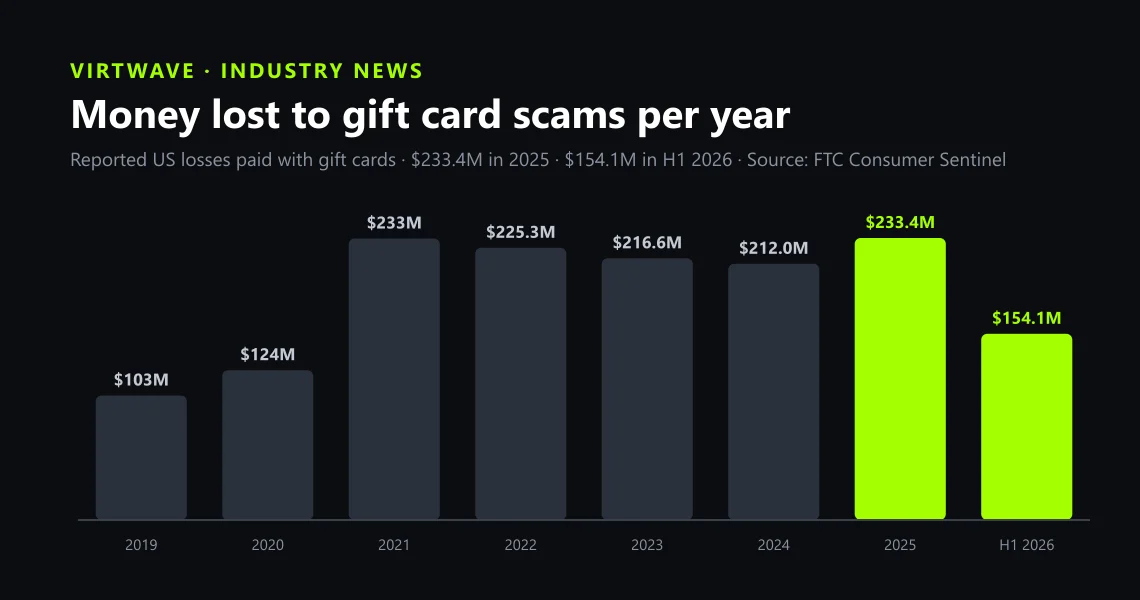
Money reported lost to scams paid with gift cards, by year
Source: Federal Trade Commission — Consumer Sentinel Network Data Book 2019; Federal Trade Commission — Consumer Sentinel Network Data Book 2020; Federal Trade Commission — Consumer Sentinel Network Data Book 2021; Federal Trade Commission — Consumer Sentinel Network: Fraud Reports by Payment Method (Tableau dashboard)
Fraud reports naming gift cards as the payment method, by year
Source: Federal Trade Commission — Consumer Sentinel Network Data Book 2019; Federal Trade Commission — Consumer Sentinel Network Data Book 2020; Federal Trade Commission — Consumer Sentinel Network Data Book 2021; Federal Trade Commission — Consumer Sentinel Network: Fraud Reports by Payment Method (Tableau dashboard)
| Year | Data Book reports | Data Book losses | Dashboard reports (June 2026) | Dashboard losses (June 2026) |
|---|---|---|---|---|
| 2019 | 38,401 | $103M | not shown | not shown |
| 2020 | 43,242 | $124M | not shown | not shown |
| 2021 | 64,638 | $233M | not shown | not shown |
| 2022 | 48,800 | $228M | 48,888 | $225.3M |
| 2023 | 41,632 | $217M | 41,635 | $216.6M |
| 2024 | 41,120 | $212M | 41,122 | $212.0M |
| 2025 | not yet published | not yet published | 35,321 | $233.4M |
The 2019 Data Book called the category “Gift\Reload Cards”; from 2020 it is “Gift Card or Reload Card”.
Source: Federal Trade Commission — Consumer Sentinel Network Data Book 2019; Federal Trade Commission — Consumer Sentinel Network Data Book 2020; Federal Trade Commission — Consumer Sentinel Network Data Book 2021; Federal Trade Commission — Consumer Sentinel Network Data Book 2022; Federal Trade Commission — Consumer Sentinel Network Data Book 2023; Federal Trade Commission — Consumer Sentinel Network Data Book 2024; Federal Trade Commission — Consumer Sentinel Network: Fraud Reports by Payment Method (Tableau dashboard)
Gift-card scam reports peaked in 2021 at 64,638 and have fallen in every year since, to 35,321 in 2025. Losses did not follow them down: after dipping to $212 million in 2024 they rose to $233.4 million in 2025, level with the 2021 peak, and the first half of 2026 alone reached $154.1 million. Fewer people are reporting gift-card scams, but those who do are losing more. What these numbers do not say is how many people were scammed: they count reports to the FTC and its partners, and most victims never report.[7][4][1]
Gift card scams in 2026 so far
$154.1 million
reported lost to gift-card scams in the first half of 2026
From 20,383 reports. That is 66% of the full-year 2025 loss in six months (our calculation).
10,135 reports, $75.0 million
gift-card scam reports and losses in Q2 2026, the latest quarter
Q1 2026 works out at 10,248 reports and $79.1 million (half-year total minus Q2).
6th
rank of gift cards among 10 payment methods by number of fraud reports
Behind credit cards, payment apps, debit cards, bank transfers and wire transfers, and ahead of cryptocurrency (17,738 reports).
$43.5 million
lost to romance scams paid with gift cards in the first half of 2026
Already 69% of the 2025 total in six months (our calculation); prize and sweepstakes scams added $31.2 million.
| Scam type (FTC subcategory) | Reports | Reported losses |
|---|---|---|
| Business imposters | 5,045 | $22.5M |
| Online shopping | 3,164 | $4.6M |
| Romance scams | 2,960 | $43.5M |
| Prizes, sweepstakes & lotteries | 2,433 | $31.2M |
| Government imposters | 2,403 | $24.3M |
| Tech support scams | 818 | $5.2M |
| Family & friend imposters | 719 | $7.5M |
| Job scams & employment agencies | 383 | $1.3M |
| Miscellaneous investments | 280 | $8.0M |
| Website content | 246 | $0.5M |
Six months into 2026, gift-card scam losses stand at $154.1 million, two-thirds of the 2025 total, on 20,383 reports. If the second half matched the first, 2026 would set a new record above $300 million, but that is a projection, not FTC data, and late reports usually push half-year figures up a little. Romance scams ($43.5 million) and prize scams ($31.2 million) account for nearly half of the money.[1][2]
Gift cards vs other ways scammers get paid
6.6%
share of 2025 fraud reports with a payment method that named gift cards
35,321 of 535,092 reports that identified how the victim paid (our calculation). In the 2019 Data Book the share was 15.3%.
7th by reports, 8th by losses
rank of gift cards among the 10 payment methods the FTC tracks
Bank transfers ($2,287.5 million) and cryptocurrency ($1,781.1 million) dominate losses; gift cards ($233.4 million) are ahead only of debit cards and money orders.
3rd
rank of gift and reload cards by number of fraud reports in 2019
Behind wire transfers and credit cards in the 2019 Data Book. They ranked 5th in 2020, 4th in 2021, 5th in 2022, 7th in 2023 and 6th in 2024 in each year’s Data Book.
About 1.5%
share of all reported 2025 fraud losses paid with gift cards
$233.4 million of the $15.9 billion the FTC says consumers reported losing to fraud in 2025 (our calculation). Most reports don’t name a payment method.
| Payment method | Reports | Reported losses |
|---|---|---|
| Credit cards | 125,964 | $307.0M |
| Payment app or service | 112,147 | $430.8M |
| Debit card | 95,716 | $205.0M |
| Bank transfer or payment | 49,593 | $2,287.5M |
| Cryptocurrency | 46,885 | $1,781.1M |
| Wire transfer | 44,515 | $335.0M |
| Gift card or reload card | 35,321 | $233.4M |
| Cash | 15,266 | $376.2M |
| Check | 7,254 | $242.0M |
| Money order | 2,431 | $48.5M |
Gift cards were the scammer’s favourite payment in the late 2010s: third by reports in the 2019 Data Book and, on the FTC’s narrower Data Spotlight count, the single most reported payment method every year from 2018 to September 2021. By 2025 they had dropped to seventh by reports and eighth by losses. That is not because gift-card scams disappeared: losses are higher than ever. It is because bank transfers and cryptocurrency let scammers take far larger sums in one go, so they grew much faster.[9][10][1]
Which scams ask for gift cards?
$63.5 million
lost to romance scams paid with gift cards, the costliest gift-card scam type
27% of all gift-card scam losses in 2025, from 5,044 reports; up from $51.7 million in 2024.
9,295
gift-card reports about business impersonators, the most common gift-card scam
Reported losses of $30.6 million. Reports fell 32% from 13,679 in 2024.
$42.2 million
lost to government impersonators who demanded gift cards
From 4,361 reports, the second-largest gift-card loss after romance scams; $37.8 million in 2024.
$39.3 million
lost to prize, sweepstakes and lottery scams paid with gift cards
From 2,993 reports, up from $33.9 million in 2024. Victims are told to pay “fees” or “taxes” on a prize that does not exist.
1,571
gift-card reports about tech support scams
Losses of $7.8 million, down from 2,700 reports and $13.8 million in 2024.
Nearly half
of people who paid a government impersonator said they paid with gift cards
Nearly 45% of those who paid someone posing as a friend or relative used gift cards, and about a third of tech support and business impersonation victims.
| Scam type (FTC subcategory) | Reports 2025 | Losses 2025 | Reports 2024 | Losses 2024 |
|---|---|---|---|---|
| Business imposters | 9,295 | $30.6M | 13,679 | $45.4M |
| Online shopping | 5,340 | $6.3M | 4,576 | $7.3M |
| Romance scams | 5,044 | $63.5M | 4,759 | $51.7M |
| Government imposters | 4,361 | $42.2M | 6,143 | $37.8M |
| Prizes, sweepstakes & lotteries | 2,993 | $39.3M | 2,849 | $33.9M |
| Family & friend imposters | 1,653 | $8.3M | 2,024 | $7.2M |
| Tech support scams | 1,571 | $7.8M | 2,700 | $13.8M |
| Job scams & employment agencies | 777 | $4.6M | 1,017 | $4.3M |
| Advance-fee credit | 598 | $2.8M | 643 | $1.9M |
| Miscellaneous investments | 585 | $12.2M | 749 | $7.9M |
Gift-card scam losses by scam type, 2025
Impersonation is the classic gift-card scam: someone posing as Amazon, Apple, a bank, the IRS or the Social Security Administration says there is a problem and that gift cards will fix it. Business impersonators still bring the most gift-card reports, but those reports fell by a third in 2025, and tech support reports fell 42%. The money has moved to scams built on a relationship or a promise: romance scams paid with gift cards rose to $63.5 million and prize scams to $39.3 million. Online shopping reports are common but small, because gift cards are a normal way to pay many legitimate retailers.[2][10]
How much victims lose, and which cards scammers ask for
$1,000
median reported loss when a scammer was paid with gift cards
Up from $700 in 2018. The FTC has not published a gift-card median since this Data Spotlight.
$840
median individual gift-card scam loss, January 2018 – September 2020
Across nearly $245 million reported lost in that period (Data Spotlight basis: direct reports to the FTC, online shopping excluded).
14%
share of gift-card scam reports with a loss of $5,000 or more
Up from about 8% in 2018. Those large losses made up $111 million of the $148 million lost in the first nine months of 2021.
26.6%
share of people reporting a fraud loss who paid with gift cards, 2018 to September 2021
About one in four. Gift cards were the most reported fraud payment method in 2018, 2019, 2020 and early 2021 on the Data Spotlight basis.
About $35 million
lost on Target gift cards, more than twice any other brand
Target cards also had the highest median loss ($2,500), and 30% of people who paid with them lost $5,000 or more.
37%
share of gift-card scam reports where the scam started with a phone call
Followed by email (18%) and social media (16%), excluding reports with no contact method.
| Gift card brand | Median reported loss | Reports with a loss of $5,000+ |
|---|---|---|
| Target | $2,500 | 30% |
| Walmart | $1,380 | 12% |
| Apple | $800 | 13% |
| eBay | $600 | 3% |
| Google Play | $500 | 6% |
The FTC identifies brands by searching report narratives; it has not published brand data since this December 2021 Data Spotlight.
- Scammers name the brand: in the first nine months of 2021 the most money was lost on Target cards, then Google Play, Apple, eBay and Walmart.
- The brand mix keeps shifting: iTunes was the top brand before Google Play, then eBay led in 2020; eBay, Google Play, Target, iTunes and Amazon made up about 39% of 2020 gift-card reports.
- Scammers also name the shop, sending victims to Target, Walmart, Best Buy, CVS and Walgreens, often to several stores in turn.
- They keep victims on the phone throughout and coach them on what to tell a cashier who asks questions.
The FTC’s most detailed gift-card analysis is from 2021 and shows losses getting bigger, not just more frequent: the median loss rose from $700 in 2018 to $1,000, and the share of reports over $5,000 nearly doubled to 14%. Those large losses made up three-quarters of the money. The 2025 data point the same way, with fewer reports but higher total losses. These median and brand figures use the Data Spotlight’s base (direct reports to the FTC, online shopping excluded), so they are not directly comparable with the Data Book totals above.[10][1]
What FBI data says about gift card scams
31%
share of FBI IC3 romance-scam complaints where victims paid with gift or prepaid cards
The largest payment type for confidence/romance fraud, ahead of cryptocurrency (25%) and wire transfer/ACH (21%).
28%
share of FBI IC3 extortion complaints paid with gift or prepaid cards
Tied with cryptocurrency (28%) as the top payment type for extortion, which includes sextortion.
31%
share of IC3 complaints from people aged 17 or younger that involved gift or prepaid cards
The largest payment type for minors, who filed 13,168 complaints and lost $12,988,892 in 2025.
The FBI’s Internet Crime Complaint Center counted 1,008,597 complaints and $20.877 billion in losses in 2025, but it does not total losses by payment method. What it does show is where gift cards matter: they were the most common payment in romance scams and, together with crypto, in extortion, and the most common payment for children and teenagers who reported a crime. For government impersonation and tech support scams, cryptocurrency has overtaken gift cards.[17]
How many people are targeted? Survey data
More than 1 in 3
US adults who have been asked by a scammer to pay with a gift card
AARP survey of 2,179 adults (third-party, not FTC data). About a quarter of those targeted bought the cards, losing $200 on average.
39% vs 28%
share of adults aged 18–49 vs 50+ who say they were targeted by a gift-card payment scam
AARP survey (third-party). Younger adults were targeted more often.
About 1 in 4
gift-card scam victims who were warned by a store employee at the till
AARP survey (third-party) of people who bought gift cards to pay a supposed obligation.
Nearly 1 in 4
US adults who don’t know or are unsure whether a demand for gift-card payment is a scam
AARP Gift Card Payment Scams report (third-party). One in ten respondents said they had bought a gift card after being asked to pay a bill, fee or prize charge.
AARP’s 2022 survey found that more than a third of US adults had been asked by a scammer to pay with a gift card, and that younger adults (39% of 18–49-year-olds) were targeted more often than people over 50 (28%). About a quarter of those targeted paid. Store staff matter: about one in four victims who bought cards was warned at the till, and AARP’s earlier research found that more than half of potential victims avoid a loss when a third party steps in.[18]
Gift card scams in the wider fraud picture
$15.9 billion
total fraud losses reported to the FTC, from 3 million fraud reports
Up from more than $12.5 billion in 2024. Gift cards are one of ten payment methods behind these losses.
$3.5 billion
reported lost to imposter scams, the category behind most gift-card demands
From 1,005,338 imposter reports. Nearly $1 billion went to business impersonators and about $920 million to government impersonators.
$195.9 billion
FTC estimate of the total cost of fraud to US consumers once underreporting is counted
Against $12.5 billion actually reported. The FTC does not split the estimate by payment method.
4.8%
share of mass-market fraud victims who complained to the BBB or a government body
From a study the FTC cites to explain why reported losses are only a fraction of real ones.
Gift cards account for a small and shrinking slice of reported fraud: about 1.5% of the $15.9 billion consumers reported losing in 2025. Investment scams alone took $7.9 billion. But gift-card scams reach people that bank-transfer and crypto scams often don’t, such as teenagers, people paying a supposed fee or fine, and anyone told a quick favour is needed, and the loss is hard to reverse once the card numbers are shared. Because only about 5% of victims complain to a government body, the FTC estimates the real cost of all fraud in 2024 could have been as high as $195.9 billion.[13][1][16][17]
- No real business or government agency will ask you to pay with a gift card. Anyone who does is a scammer.
- If you paid a scammer with a gift card, keep the card and receipt and contact the card’s issuer straight away. The FTC lists issuer contacts at ftc.gov/giftcards.
- Report the scam at ReportFraud.ftc.gov (US); reports are what these statistics are built from.
Methodology and caveats
Every figure was read by our team on 14 October 2026 from the primary source: the FTC’s Consumer Sentinel Network Data Books for 2019 to 2024 (the “Fraud Reports by Payment Method” page in each), the FTC’s live Consumer Sentinel dashboards on Tableau Public (Payment & Contact Methods, Subcategory Payment & Contact, Fraud Facts; published 28 July 2026 with data to 30 June 2026), FTC Data Spotlights and press releases, the FTC’s March 2026 testimony to Congress and the FBI’s 2025 Internet Crime Report. Two AARP surveys are the only third-party sources and are labelled.
A “gift-card scam” here means a fraud report in which the consumer said they paid with a gift card or reload card. 2019–2021 figures are as printed in each year’s Data Book; 2022 onwards come from the dashboard, which also restates 2022–2024 slightly. Where we calculated a share, change or rank from the FTC’s numbers, the figure says so.
The FTC has not yet published its 2025 Data Book. When it does, and when the dashboards add Q3 2026, we will re-check every figure and note any restatements in the update log.
- Consumer Sentinel figures are reports, not a survey: they count people who chose to report to the FTC or one of its data contributors, and the FTC notes most fraud is never reported. Treat every total as a floor.
- Losses are reported losses, as stated by consumers (between $1 and $999,999 per report), and are not verified. One report can cover several gift cards.
- The FTC updates earlier years as late reports arrive, so a year’s figure in its own Data Book can differ slightly from the current dashboard. This page names the edition for each number.
- The 2020 and 2021 Data Spotlights count only reports made directly to the FTC and exclude online-shopping reports, so their totals (for example 36,682 gift-card reports in 2020) are lower than the Data Book’s 43,242 and must not be mixed with the yearly series.
- The FTC did not collect reports during the 2025 government shutdown, so 2025 counts are slightly understated.
- First-half 2026 figures cover six months and will rise as late reports arrive. FBI IC3 shares are read from pie charts and are percentages of complaints, not of dollars.
How we research and correct our content is set out in our editorial policy.
Gift Card Scam Statistics 2026: FAQ
How much money is lost to gift card scams each year?
Americans reported losing $233.4 million to scams paid with gift cards or reload cards in 2025, according to FTC Consumer Sentinel data, up from $212 million in 2024 and $103 million in 2019. In the first half of 2026 alone, reported losses reached $154.1 million. Real losses are higher, because most victims never report.
How many people fall for gift card scams?
The FTC received 35,321 fraud reports in 2025 in which people said they paid a scammer with a gift card, down from a peak of 64,638 in 2021. In AARP’s 2022 survey, more than a third of US adults said a scammer had asked them to pay with a gift card, and about a quarter of those paid.
Are gift card scams increasing?
Losses are increasing but reports are not. Gift-card scam losses rose 10% to $233.4 million in 2025 while reports fell 14% to 35,321, and the first half of 2026 reached $154.1 million, two-thirds of the 2025 total. Fewer victims are reporting, but each is losing more.
What is the most common gift card scam?
By number of reports, business impersonation is the most common gift-card scam: 9,295 FTC reports in 2025 involved someone posing as a company. By money lost, romance scams are the worst, with $63.5 million paid through gift cards in 2025, followed by government impersonators ($42.2 million) and prize or sweepstakes scams ($39.3 million).
Why do scammers ask for gift cards?
Gift cards are sold everywhere, can be turned into cash quickly and offer buyers fewer protections than credit cards. Once a victim reads out the numbers on the back, the money is usually gone. The FTC’s rule of thumb: anyone who demands payment by gift card is a scammer.
What is the average loss in a gift card scam?
The FTC’s most recent gift-card median is $1,000, for January–September 2021, up from $700 in 2018. Losses vary by brand: the median loss on Target cards was $2,500. About 14% of gift-card scam reports involved losses of $5,000 or more.
Which gift cards do scammers ask for most?
In the FTC’s latest brand analysis (January–September 2021), the most money was lost on Target gift cards, about $35 million and more than twice any other brand, followed by Google Play, Apple, eBay and Walmart. Scammers switch brands over time; eBay led in 2020 and iTunes before that.
Cite or reuse these statistics
Every figure in this report is free to reuse in articles, videos, research and AI-written content under CC BY 4.0. The one condition: credit Virtwave with a link to this page, so your readers can check the number and see when it was last updated.
https://www.virtwave.com/industry-news/gift-card-scam-statistics<a href="https://www.virtwave.com/industry-news/gift-card-scam-statistics">Gift Card Scam Statistics 2026 (Virtwave)</a>Haddad, N. (2026). Gift Card Scam Statistics 2026. Virtwave. https://www.virtwave.com/industry-news/gift-card-scam-statisticsSources
- Federal Trade CommissionFirst-partyConsumer Sentinel Network: Fraud Reports by Payment Method (Tableau dashboard)Accessed — Published 28 July 2026, data as of 30 June 2026. Filtered to each full year 2022–2025 and to 2026 Q1–Q2: reports and losses for every payment method.
- Federal Trade CommissionFirst-partyConsumer Sentinel Network: Subcategory Payment & Contact (Tableau dashboard)Accessed — Top ten fraud subcategories for the “Gift Card or Reload Card” payment method, for 2024, 2025 and 2026 year to date.
- Federal Trade CommissionFirst-partyConsumer Sentinel Network: Fraud Facts (Tableau dashboard)Accessed — Imposter scams, 2025: 1,005,338 reports and $3,528.1 million reported lost.
- Federal Trade CommissionFirst-partyConsumer Sentinel Network Data Book 2024Accessed — Page 11, Fraud Reports by Payment Method: gift card or reload card 41,120 reports, $212M.
- Federal Trade CommissionFirst-partyConsumer Sentinel Network Data Book 2023Accessed — Page 11: gift card or reload card 41,632 reports, $217M (7th of 10 by reports).
- Federal Trade CommissionFirst-partyConsumer Sentinel Network Data Book 2022Accessed — Page 11: gift card or reload card 48,800 reports, $228M.
- Federal Trade CommissionFirst-partyConsumer Sentinel Network Data Book 2021Accessed — Page 11: gift card or reload card 64,638 reports, $233M.
- Federal Trade CommissionFirst-partyConsumer Sentinel Network Data Book 2020Accessed — Page 11: gift card or reload card 43,242 reports, $124M (5th of 11 by reports).
- Federal Trade CommissionFirst-partyConsumer Sentinel Network Data Book 2019Accessed — Page 11: “Gift\Reload Cards” 38,401 reports, $103M, of 250,678 reports with a payment method.
- Federal Trade CommissionFirst-partyData Spotlight: Scammers prefer gift cards, but not just any card will do (December 2021)Accessed — Gift-card reports and losses 2018 – September 2021, median losses, $5,000+ share, brands, retailers and contact methods (footnotes 1–8).
- Federal Trade CommissionFirst-partyFTC Data Show Major Increase in Gift Cards as Scam Payment Method (press release, December 2021)Accessed — Target gift cards: about $35 million lost, more than twice any other brand.
- Federal Trade CommissionFirst-partyData Spotlight: Gift cards top scammers’ wish lists (December 2020)Accessed — January 2018 – September 2020: $840 median loss, share of impersonation victims paying with gift cards, top brands.
- Federal Trade CommissionFirst-partyPrepared Statement of the FTC on The Rising Scam Economy, Joint Economic Committee (25 March 2026)Accessed — 2025 totals (3 million fraud reports, $15.9 billion), and the $195.9 billion estimate of 2024 fraud costs including underreporting.
- Federal Trade CommissionFirst-partyNew FTC Data Show a Big Jump in Reported Losses to Fraud to $12.5 Billion in 2024 (press release, March 2025)Accessed — 2024 total reported fraud losses.
- Federal Trade CommissionFirst-partyFTC Data Show People Reported Losing $3.5 Billion to Imposter Scams in 2025 (press release, June 2026)Accessed — Imposter, business-impersonator and government-impersonator losses in 2025.
- Federal Bureau of Investigation, Internet Crime Complaint CenterFirst-party2025 IC3 Internet Crime ReportAccessed — Page 10 (top transaction types by crime type) and page 34 (complainants 17 or younger), read from the rendered charts; complaint and loss totals on page 6.
- AARPAARP Survey: 1 in 3 Adults Hit by Gift Card Payment Scams (April 2022)Accessed — Third-party survey of 2,179 US adults (AmeriSpeak, January–February 2022): targeting, payment, age gap and store warnings.
- AARPNew Research Shows Prevalence of Gift Card Use as Payment in Scams (press release, April 2021)Accessed — Third-party: AARP Gift Card Payment Scams report findings.
Who compiled this report
Data & Market Research Lead, Virtwave · Built and maintains this calculator
Noor runs market research for Virtwave, tracking gift card volumes, redemption patterns and fraud trends across the 80+ countries we deliver to. She compiles our data reports from primary government sources (FTC, central banks) and the major market-research houses, and cross-checks every figure against our own transaction data before publication.
Lead Editorial, Virtwave · Checks every figure before an update
Layla leads the Virtwave content desk. She oversees every blog post before publication, with a focus on long-form gift card guides, payment wallets, and SEO best practice for the gift card industry.
Virtwave sells game keys and gift cards, including Steam wallet codes. No platform or publisher paid for, reviewed or approved this report.
Update history
Published 14 Oct 2026: with the FTC’s Consumer Sentinel dashboards (data to 30 June 2026), the 2019–2024 Data Books, the 2020 and 2021 gift-card Data Spotlights, FTC press releases and March 2026 testimony, the FBI’s 2025 IC3 report and two AARP surveys.