Can you check if a Steam key is valid without redeeming it?
Not fully, and any site that claims otherwise is guessing. You can check that a key is in a format Steam uses — that is what this checker does — but whether it has been used can only be looked up in Steamworks by the publisher that generated it. Valve’s own documentation says the Query Steam Key page works only for accounts with the “Generate Steam Keys” permission, and only for keys from their own batches.
How do I check if a Steam key has already been used?
As a buyer, the only way is to redeem it: if someone else has, Steam says the code “has already been activated by a different Steam account” and you should go back to the seller. As the publisher, look the key up on the Steamworks Query Steam Key page — one key at a time — or use the publisher report on this page, which runs that lookup for a whole list from your own logged-in browser.
What does a Steam key look like?
The Steam client’s own activation dialog gives three examples: AAAAA-BBBBB-CCCCC, AAAAA-BBBBB-CCCCC-DDDDD-EEEEE, 237ABCDGHJLPRST 23. The first — three groups of five letters and digits — is the standard Steam key; the 25-character version is what Valve says boxed retail games print. Valve does not publish the character set, whether keys are case-sensitive, or any checksum, so no checker can prove a key is genuine from its shape alone.
Is it safe to paste my Steam keys into this checker?
Yes — the check runs entirely in your browser tab, and no key is sent to Virtwave or anyone else. Keys are masked on screen by default so a screenshot does not leak them, and nothing is saved when you close or reload the page. You can confirm it yourself: open your browser’s network panel, paste a list, and you will see no request carrying it.
How do publishers check Steam key activation status in bulk?
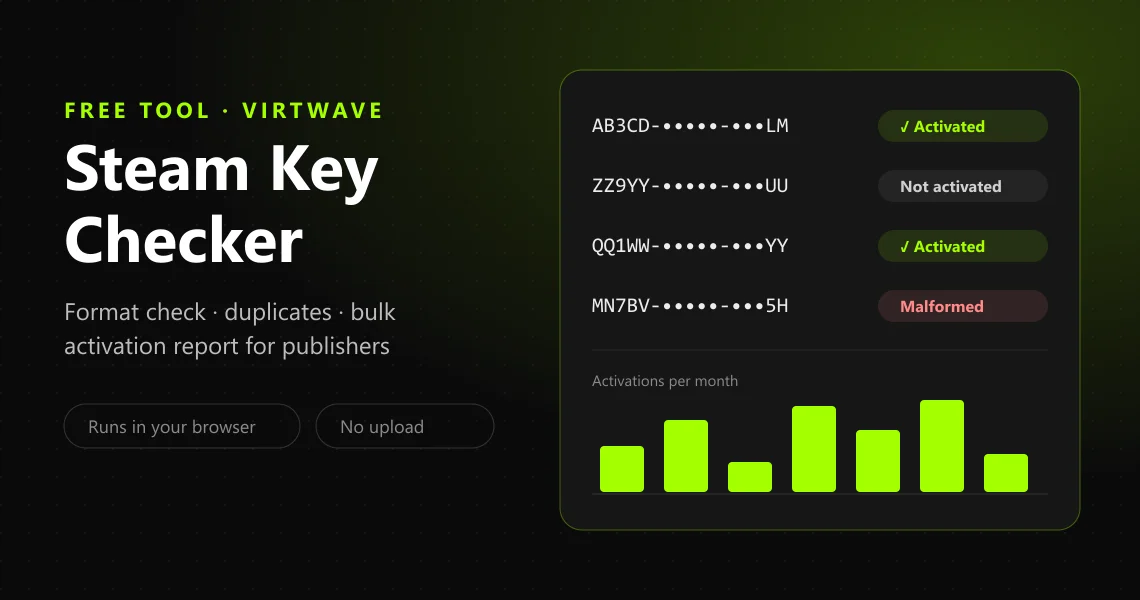
Steamworks only answers one key at a time, on its Query Steam Key page. This tool writes a short script that asks that page about each key in turn, from your own logged-in browser, and saves the answers as a CSV — up to 500 keys per run, one lookup at a time with a pause between them. Load the CSV back here and you get activated vs unused, activations by month, and the split by key tag, channel or country.
Can I see which country a Steam key was activated in?
Not key by key. Steamworks reports activations by country and region in aggregate: Valve says publishers see “Steam Key activation data grouped by tag and by country”, and on 2 September 2026 it added a key-activations chart that toggles between region and country of activation. To see where individual keys went, add the channel or country you sent each key to as a column in your list — the report here then shows the activation rate for each.
Why does Steam say my key is invalid?
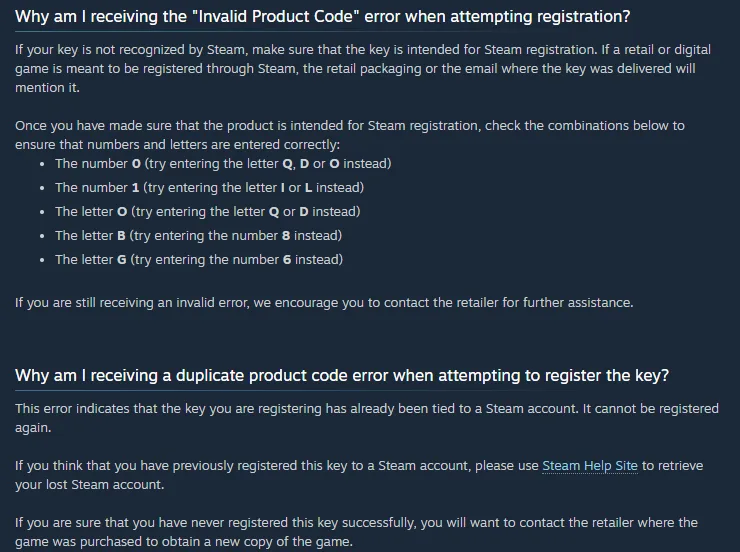
Usually a typo: Valve’s own error message warns that “I, L, and 1 can look alike, as can V and Y, and 0 and O”, and its Retail CD Keys FAQ adds Q, D, B/8 and G/6. The other common cause is that it is not a Steam product key at all — a Steam Wallet code, which is redeemed on a different page, or a key for another launcher. If neither applies, it has to go back to the seller.
How long does “too many activation attempts” last on Steam?
Valve does not say. The message only asks you to “wait and try your product code again later”, and the one-hour figure repeated on other sites does not come from Valve. The practical advice is to stop, wait, and not keep retrying, and to check your keys’ format first so you do not burn attempts on typos.
What happens if a Steam key I bought gets revoked?
The game is removed from your library, but your account is not punished: Valve’s words are “Your account will not be restricted; however, the CD Key you received will be removed.” Publishers can revoke keys that were obtained fraudulently, and Valve cannot refund a purchase made outside Steam, so buy from sellers that source keys from the publisher or an authorised distributor.
Is a Steam Wallet code the same as a Steam key?
No. A Steam key adds a game or DLC to your library and is redeemed at Activate a Product; a Steam Wallet code adds money to your wallet and is redeemed on the separate “Redeem a Steam Gift Card or Wallet Code” page. Valve does not document the wallet code format, and they commonly look alike, so a wallet code typed into the product activation box comes back as an invalid product code. Valve’s Steam Wallet FAQ, updated in June 2026, also says physical Steam gift cards are ending at retail: “We expect all retailers to be out of stock by the end of 2026.”
Why does a key from Steam’s own “CD keys” menu not work on Steam?
Because it is not meant for Steam. The keys listed when you right-click a game and choose Manage → CD keys are, in Valve’s words, “used to register your product outside of Steam, with a third party client or service” — another publisher’s launcher, for example. If one of those fails, Valve sends you to that third-party publisher’s support, not Steam’s.
Can a Steam key be used twice?
No. Valve describes Steam keys as “single-use, unique, alphanumeric codes”. Valve’s Retail CD Keys FAQ says an activated key “has already been tied to a Steam account. It cannot be registered again” — which is exactly why a key that has been activated before is worthless to anyone else.