Industry News · Gift cards statistics
Gift Card Statistics 2026: Market Size, Holiday Spending & Unused Balances (Fed, NRF & SEC Data)
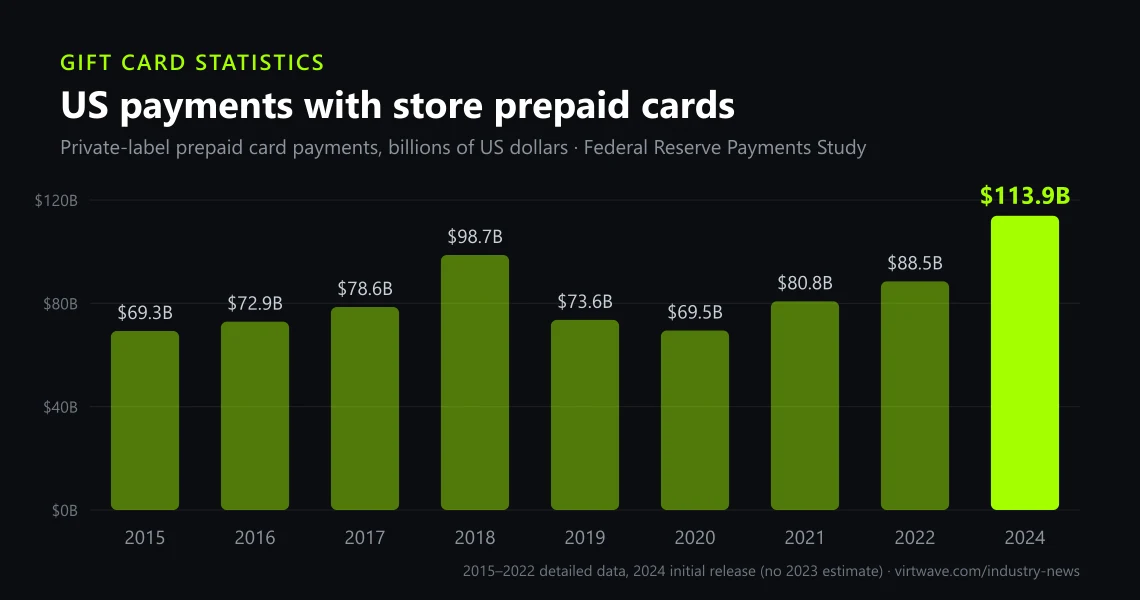
Americans paid $113.9 billion with store (private-label) prepaid cards in 2024, across 6.7 billion payments, the Federal Reserve says. NRF expected $29.1 billion of gift cards to be bought for the 2025 holidays, and 47% of shoppers want one in 2026. Amazon alone held $5.6 billion of unredeemed gift cards at the end of 2025.
Key takeaways
- Store prepaid cards (the Fed’s “private-label” category, where closed-loop gift cards sit) carried $113.9 billion in 6.73 billion payments in 2024, up 11.5% a year in value since 2021, at an average of just $16.91 per payment.
- Holiday gift card spending is flat in dollars: NRF’s estimates sit between $28.1 billion and $29.3 billion every year from 2021 to 2025, while the share of shoppers planning to give one slipped from 45% to 43%.
- Gift cards are still the most-wanted holiday gift, but less clearly so each year: 55% wanted one in October 2023, 53% in 2024, 50% in 2025 and 47% in 2026.
- Unspent balances are large: six US retailers alone reported more than $11.7 billion of unredeemed gift cards in their latest annual reports, led by Amazon ($5.6 billion) and Walmart ($2.94 billion).
- Breakage is real money: Starbucks recognised $222.4 million of revenue from cards it expects never to be redeemed in fiscal 2025, up from $140.8 million in fiscal 2019.
- Federal law protects the balance for at least five years and bans inactivity fees in the first 12 months; California now makes balances under $15 redeemable for cash.
Key figures
$113.9 billion
paid with private-label (store) prepaid cards in the US
The Federal Reserve’s category for prepaid cards used on proprietary networks at specific merchants — where closed-loop store gift cards and reloadable store cards such as coffee-chain cards sit. It is the closest official measure of store gift card spending.
$29.1 billion
expected US holiday gift card spending
Up from $28.6 billion in 2024. NRF/Prosper survey of 8,000 adults, margin of error ±1.1 points.
47%
of US consumers who want to receive a gift card this holiday season — still the top wish-list item
Ahead of clothing (44%), books and other media (25%) and personal care or beauty (24%). Survey of 8,094 adults, 1–7 October 2026.
$5.6 billion
Amazon’s liability for unredeemed gift cards
Up from $3.3 billion at the end of 2019. Included in “accrued expenses and other”; Amazon recognises the share it does not expect to be redeemed based on customer usage patterns.
$222.4 million
Starbucks breakage revenue — money from stored value cards it expects never to be redeemed
$200.4 million in company-operated store revenue plus $22.0 million in licensed store revenue. Starbucks cards in the US have no expiry date and no fees that reduce balances.
$649.6 billion
value of all US prepaid card payments
Store cards $113.9 billion, general-purpose prepaid $425.7 billion and government benefit (EBT) cards $110.1 billion.
5 years
minimum life of the money on a US gift card under federal law
Under Regulation E (12 CFR 1005.20), funds on a gift certificate, store gift card or general-use prepaid card cannot expire until at least five years after issue or the last load, or the card’s own expiry date if later.
807
gift card complaints sent to companies through the CFPB
Down from a record 905 in 2024. Counts complaints filed under the CFPB’s gift card sub-products.
How big is the US gift card market?
No official statistic is labelled “gift cards”. The closest is the Federal Reserve Payments Study, which counts every card payment in the US. Its private-label prepaid category — cards used on a proprietary network at specific merchants — is where store gift cards and reloadable store cards live. Network-branded gift cards (the Visa or Mastercard cards sold on racks) sit inside general-purpose prepaid alongside payroll and reloadable bank cards.[5][1]
$113.9 billion
paid with private-label (store) prepaid cards in the US
The Federal Reserve’s category for prepaid cards used on proprietary networks at specific merchants — where closed-loop store gift cards and reloadable store cards such as coffee-chain cards sit. It is the closest official measure of store gift card spending.
6.73 billion
payments made with private-label (store) prepaid cards
Up from 5.20 billion in 2021 (9.0% compound annual growth) and 4.37 billion in 2015.
$16.91
average payment with a store prepaid card
Less than half the $36.02 average for general-purpose prepaid cards and a sixth of the $96.91 credit card average in the same table — store cards are used for small, frequent purchases.
+11.5% a year
compound annual growth in the value of store prepaid card payments, 2021–2024
Number of payments grew 9.0% a year over the same period. Between 2018 and 2021 both had fallen (value −6.4% a year), largely because of the 2020 pandemic dip.
$649.6 billion
value of all US prepaid card payments
Store cards $113.9 billion, general-purpose prepaid $425.7 billion and government benefit (EBT) cards $110.1 billion.
21.3 billion
payments made with all prepaid cards (store, general-purpose and EBT)
11.3% of the 187.7 billion card payments in 2024 (our calculation). The Fed counts prepaid cards as a type of debit card.
11.8 billion payments, $425.7 billion
general-purpose prepaid card payments (network-branded prepaid, including Visa and Mastercard gift cards)
Average $36.02. This category also includes payroll and reloadable bank prepaid cards, so it is not a gift card total.
3.6%
share of all US card payments made with store prepaid cards
6.73 billion of 187.7 billion card payments, but only about 1% of card payment value ($0.11 trillion of $11.50 trillion) — our calculation from the Fed’s table.
2.73 billion payments, $110.1 billion
government benefit (EBT) card payments, counted inside prepaid
Down from 4.76 billion and $164.3 billion in 2021, when pandemic benefits peaked; worth subtracting when anyone quotes “prepaid” as if it were gift cards.
8x
growth in the value of US prepaid card payments since 2006
From $0.08 trillion in 2006 to $0.65 trillion in 2024 in the Fed’s long-run series (our ratio; EBT is included throughout).
236.6 billion
noncash payments of all kinds in the US — the universe store cards are measured against
Cards were over three-quarters of payments by number; credit card payments grew faster than debit for the first time in almost a decade.
Value of store (private-label) prepaid card payments
Source: Federal Reserve Board — Federal Reserve Payments Study: Networks, Processors and Issuers Payments Surveys data, 2015–2022 (Excel); Federal Reserve Board — Federal Reserve Payments Study — Initial Data Release, National Estimates for Calendar Years 2015, 2018, 2021 and 2024 (Excel)
Number of store (private-label) prepaid card payments
Source: Federal Reserve Board — Federal Reserve Payments Study: Networks, Processors and Issuers Payments Surveys data, 2015–2022 (Excel); Federal Reserve Board — Federal Reserve Payments Study — Initial Data Release, National Estimates for Calendar Years 2015, 2018, 2021 and 2024 (Excel)
| Card type | Payments | Value | Average payment | Value growth a year, 2021–24 |
|---|---|---|---|---|
| Private-label (store) prepaid | 6.73 billion | $113.9 billion | $16.91 | +11.5% |
| General-purpose prepaid | 11.82 billion | $425.7 billion | $36.02 | +4.3% |
| Government benefit (EBT) | 2.73 billion | $110.1 billion | $40.28 | −12.5% |
| All prepaid | 21.29 billion | $649.6 billion | $30.52 | +1.5% |
| For comparison: all credit cards | 67.15 billion | $6,507.4 billion | $96.91 | +10.1% |
Growth is the Fed’s compound annual growth rate in value.
Value of all US prepaid card payments since 2006
What the numbers say: store prepaid cards are a small slice of card payments (3.6% by number, about 1% by value) but a fast-growing one again — $113.9 billion in 2024 is a record for the series and 39% above 2021’s restated $82.2 billion. What they do not say: how much of that is gift cards rather than reloadable loyalty cards, which dominate by number. The Fed has not yet published the 2024 reloadable split; in 2022 non-reloadable store cards — the classic gift card — carried $21.7 billion.[1][4]
Store cards vs Visa-style gift cards: reloadable, one-off and online
5.41 billion payments, $88.5 billion
private-label (store) prepaid card payments in 2022, the last year with detailed splits
From the Fed’s 2015–2022 networks, processors and issuers data (a slightly different edition from the 2024 release).
4.85 billion payments, $66.7 billion
payments with reloadable store prepaid cards
90% of store prepaid payments by number and 75% by value (our calculation). Average $13.76 — the coffee-card pattern of small top-ups spent often.
565 million payments, $21.7 billion
payments with non-reloadable store prepaid cards — the classic one-off store gift card
Average payment $38.50, almost three times the reloadable average.
649 million payments, $38.3 billion
payments with non-reloadable general-purpose prepaid cards (the category holding Visa/Mastercard-style gift cards)
Average $59.09, the highest of any prepaid card type. Down from 902 million payments in 2021.
27%
share of store prepaid card payments made remotely (online, in-app, by phone)
1.48 billion of 5.41 billion payments, worth $22.5 billion, up from 0.8 million remote payments in 2015 — digital redemption went from almost nothing to over a quarter in seven years.
4.63 billion
store prepaid card payments in 2020, the low point of the series
In-person payments fell from 5.06 billion in 2019 to 3.80 billion while remote payments rose from 0.57 billion to 0.82 billion.
| Category | Card type | Payments | Value | Average payment |
|---|---|---|---|---|
| Store (private-label) | Reloadable | 4.85 billion | $66.7 billion | $13.76 |
| Store (private-label) | Non-reloadable | 0.565 billion | $21.7 billion | $38.50 |
| General-purpose | Reloadable | 8.32 billion | $314.5 billion | $37.82 |
| General-purpose | Non-reloadable | 0.649 billion | $38.3 billion | $59.09 |
Non-reloadable cards are where most gift cards sit, but the categories also hold non-gift products (for example one-off payout cards). 2022 is the latest year with this split.
Two patterns stand out. First, one-off cards are spent in bigger chunks: $38.50 per payment on a non-reloadable store card and $59.09 on a Visa-style card, against $13.76 on a reloadable store card. Second, store cards moved online fast — remote payments went from 0.8 million in 2015 to 1.48 billion in 2022, 27% of the total — while the 2020 pandemic cut in-person use by a quarter.[4]
Holiday gift card spending and who buys them
$29.1 billion
expected US holiday gift card spending
Up from $28.6 billion in 2024. NRF/Prosper survey of 8,000 adults, margin of error ±1.1 points.
43%
of holiday shoppers planning to give gift cards
The second most popular gift after clothing and accessories (50%) and ahead of toys (32%).
$171.32
average planned gift card spending per holiday shopper
Spread across three to four gift cards. It was $165.87 in 2022, $166.69 in 2023 and $170.48 in 2024.
27%
of gift card buyers choosing restaurant cards, the most popular type
Followed by bank-issued cards (25%), department stores (25%) and coffee shops (20%).
Over half
of shoppers aged 65 or over planning to buy a gift card, more than any other age group
From NRF’s December 2025 analysis of the same survey; 43% of all shoppers plan to buy at least one.
47%
of US consumers who want to receive a gift card this holiday season — still the top wish-list item
Ahead of clothing (44%), books and other media (25%) and personal care or beauty (24%). Survey of 8,094 adults, 1–7 October 2026.
55% → 47%
decline in the share wanting a gift card, October 2023 to October 2026
55% (2023), 53% (2024), 50% (2025), 47% (2026). Gift cards have stayed the No. 1 request every year, but the lead over clothing narrowed from 6 points to 3.
$29.3 billion
expected holiday gift card spending in 2023, the highest of 2021–2025
Average $49.43 per card ($166.69 per person); 8,424 adults surveyed.
$51.18
average planned spend per holiday gift card
It was $51.47 in 2022 and $49.43 in 2023 — the typical holiday card is a $50 card.
10%
of gift card buyers planning to buy a food delivery card such as DoorDash or Uber Eats
From the 2022 survey, which also put total spending at $28.6 billion, up from $28.1 billion in 2021.
26%
of after-Christmas shoppers who said they would shop that week to use gift cards
70% planned to shop in the week after 25 December; using gift cards was the second reason after sales (48%).
Expected US holiday gift card spending
Source: National Retail Federation — Record 166.3 Million Shoppers Expected During Thanksgiving Weekend (17 November 2022); National Retail Federation — Latest NRF Survey Shows Top Picks for Toys and Gifts for the Winter Holidays (20 November 2023); National Retail Federation — NRF Survey Reveals Top Toys and Gifts for the Winter Holidays (21 November 2024); National Retail Federation — Thanksgiving Weekend Expected to Draw Largest Number of Shoppers on Record (20 November 2025)
Share of consumers who want a gift card for the holidays
Source: National Retail Federation — Consumers to Spend Nearly $900 to Celebrate the Winter Holidays (18 October 2023); National Retail Federation — 2024 Holiday Spending Expected to Reach New Record (22 October 2024); National Retail Federation — Consumers to Spend Second-Highest Amount on Record, According to NRF Holiday Survey (16 October 2025); National Retail Federation — Affordability Shapes Winter Holiday Shopping, According to NRF Holiday Survey (20 October 2026)
| Season | Total spending | Per person | Per card | Plan to give gift cards | Top card types |
|---|---|---|---|---|---|
| 2022 | $28.6B | $165.87 | $51.47 | 45% | Restaurant 27%, department store 26%, bank-issued 25% |
| 2023 | $29.3B | $166.69 | $49.43 | 44% | Restaurant 30%, bank-issued 26%, department store 26%, coffee 21% |
| 2024 | $28.6B | $170.48 | $51.18 | 44% | Restaurant 30%, department store 25%, bank-issued 25%, coffee 22% |
| 2025 | $29.1B | $171.32 | Not published | 43% | Restaurant 27%, bank-issued 25%, department store 25%, coffee 20% |
Samples: 7,719 (2022), 8,424 (2023), 8,135 (2024) and 8,000 (2025) adults.
Source: National Retail Federation — Record 166.3 Million Shoppers Expected During Thanksgiving Weekend (17 November 2022); National Retail Federation — Latest NRF Survey Shows Top Picks for Toys and Gifts for the Winter Holidays (20 November 2023); National Retail Federation — NRF Survey Reveals Top Toys and Gifts for the Winter Holidays (21 November 2024); National Retail Federation — Thanksgiving Weekend Expected to Draw Largest Number of Shoppers on Record (20 November 2025)
Read together, the NRF numbers describe a mature habit rather than a growth market: total holiday gift card spending has moved within about $1 billion for five years, which in real terms means it has shrunk. Per-person spending creeps up ($165.87 to $171.32) while slightly fewer people buy. Demand from recipients is cooling faster — the wish-list share fell 8 points in three years — although gift cards are still the single most-requested gift. NRF’s October 2026 survey dropped the spending estimates; expect them in its November release.[15][8][6]
Unspent balances and breakage: what retailers are holding
When you buy a gift card, the retailer books the money as a liability until it is spent. Public companies report that liability in their 10-K filings, and many also report “breakage” — the share they expect will never be redeemed, which they gradually recognise as revenue. These are the most precise unspent-balance figures that exist, because they are audited.[26][20]
$5.6 billion
Amazon’s liability for unredeemed gift cards
Up from $3.3 billion at the end of 2019. Included in “accrued expenses and other”; Amazon recognises the share it does not expect to be redeemed based on customer usage patterns.
$2.94 billion
Walmart’s deferred gift card revenue
Up from $2.76 billion a year earlier. Walmart says cards are generally redeemed within 12 months and do not expire in the US.
$1.20 billion
Target’s gift card liability
$1,197 million, down from $1,209 million; Target recognised $861 million of revenue from the opening balance during the year. Target gift cards do not expire.
$1.1 billion
Home Depot’s performance obligations for unredeemed gift cards
Unchanged from a year earlier. Home Depot says redemption generally happens within six months and breakage income was immaterial in fiscal 2023–2025.
$235 million
Best Buy’s unredeemed gift card liabilities
Down from $253 million. Over 90% of Best Buy gift card redemptions happen within one year of issue.
$636.7 million
Darden Restaurants’ deferred gift card revenue (Olive Garden and its other restaurant brands)
Gift card activations were $760.2 million in fiscal 2026. Darden recognises breakage over an expected redemption period of about 12 years.
$11.7 billion+
unredeemed gift card balances across Amazon, Walmart, Target, Home Depot, Best Buy and Darden
Our sum of the six latest annual figures (balance dates from December 2025 to May 2026). Starbucks’ $1.75 billion card-and-Stars balance would take it past $13 billion.
$222.4 million
Starbucks breakage revenue — money from stored value cards it expects never to be redeemed
$200.4 million in company-operated store revenue plus $22.0 million in licensed store revenue. Starbucks cards in the US have no expiry date and no fees that reduce balances.
+58%
growth in Starbucks breakage revenue from fiscal 2019 to fiscal 2025
From $140.8 million to $222.4 million (our calculation), faster than the 39% growth in money loaded onto cards and earned as Stars over the same years.
$15.25 billion
loaded onto Starbucks stored value cards and earned as Stars in one year
Starbucks’ “card activations, card reloads and Stars earned” — down from a record $15.81 billion in fiscal 2024 and up from $10.98 billion in fiscal 2019.
$1.75 billion
Starbucks’ deferred revenue for stored value cards and loyalty Stars
About $1.6 billion of it is current; Starbucks says the majority of stored value cards are redeemed within one year.
| Company | Unredeemed balance | Balance date | Prior year | What the filing says |
|---|---|---|---|---|
| Amazon | $5.6 billion | 31 Dec 2025 | $5.4 billion | Unredeemed share recognised based on customer usage patterns |
| Walmart | $2,941 million | 31 Jan 2026 | $2,755 million | Generally redeemed within 12 months; no expiry in the US |
| Starbucks (cards + Stars) | $1,751.7 million | 28 Sep 2025 | $1,718.7 million | Majority redeemed within one year; $222.4M breakage in FY2025 |
| Target | $1,197 million | 31 Jan 2026 | $1,209 million | Typically redeemed within one year; cards do not expire |
| Home Depot | $1.1 billion | 1 Feb 2026 | $1.1 billion | Generally redeemed within six months; breakage immaterial |
| Darden Restaurants | $636.7 million | 31 May 2026 | $628.8 million | Breakage recognised over about 12 years |
| Best Buy | $235 million | 31 Jan 2026 | $253 million | Over 90% of redemptions within one year |
Starbucks reports cards and loyalty Stars together. Darden’s figure is gross deferred gift card revenue (it also carries $31.6M of deferred gift card discounts).
Source: Amazon.com, Inc. (SEC EDGAR) — Amazon Form 10-K for the year ended 31 December 2025; Walmart Inc. (SEC EDGAR) — Walmart Form 10-K for fiscal year ended 31 January 2026; Starbucks Corporation (SEC EDGAR) — Starbucks Form 10-K for fiscal year ended 28 September 2025; Target Corporation (SEC EDGAR) — Target Form 10-K for fiscal year ended 31 January 2026; The Home Depot, Inc. (SEC EDGAR) — Home Depot Form 10-K for fiscal year ended 1 February 2026; Darden Restaurants, Inc. (SEC EDGAR) — Darden Restaurants Form 10-K for fiscal year ended 31 May 2026; Best Buy Co., Inc. (SEC EDGAR) — Best Buy Form 10-K for fiscal year ended 31 January 2026
Amazon’s liability for unredeemed gift cards
Source: Amazon.com, Inc. (SEC EDGAR) — Amazon Form 10-K for the year ended 31 December 2020; Amazon.com, Inc. (SEC EDGAR) — Amazon Form 10-K for the year ended 31 December 2021; Amazon.com, Inc. (SEC EDGAR) — Amazon Form 10-K for the year ended 31 December 2023; Amazon.com, Inc. (SEC EDGAR) — Amazon Form 10-K for the year ended 31 December 2025
Starbucks stored value card breakage revenue
Source: Starbucks Corporation (SEC EDGAR) — Starbucks Form 10-K for fiscal year ended 29 September 2019; Starbucks Corporation (SEC EDGAR) — Starbucks Form 10-K for fiscal year ended 2 October 2022; Starbucks Corporation (SEC EDGAR) — Starbucks Form 10-K for fiscal year ended 28 September 2025; Starbucks Corporation (SEC EDGAR) — Starbucks Form 10-K for fiscal year ended 2 October 2016
Money loaded onto Starbucks cards (plus Stars earned)
Source: Starbucks Corporation (SEC EDGAR) — Starbucks Form 10-K for fiscal year ended 29 September 2019; Starbucks Corporation (SEC EDGAR) — Starbucks Form 10-K for fiscal year ended 27 September 2020; Starbucks Corporation (SEC EDGAR) — Starbucks Form 10-K for fiscal year ended 2 October 2022; Starbucks Corporation (SEC EDGAR) — Starbucks Form 10-K for fiscal year ended 1 October 2023; Starbucks Corporation (SEC EDGAR) — Starbucks Form 10-K for fiscal year ended 28 September 2025
Gift card laws: expiry, fees and cash-back
5 years
minimum life of the money on a US gift card under federal law
Under Regulation E (12 CFR 1005.20), funds on a gift certificate, store gift card or general-use prepaid card cannot expire until at least five years after issue or the last load, or the card’s own expiry date if later.
12 months
of inactivity required before any dormancy, inactivity or service fee can be charged
The fee must also be disclosed on the card and before purchase.
1 fee a month
maximum number of dormancy, inactivity or service fees in any calendar month
Loyalty, award and promotional cards are excluded from these protections but must say so on the front.
Under $15
California gift card balances that must be redeemable for cash
Raised from $10 by SB 22 (2025), effective 1 January 2026 and operative 1 April 2026. California also bans expiry dates and, with narrow exceptions, service fees on gift certificates.
Under $5
Washington State gift certificate balances that must be redeemable for cash after a purchase
Washington also bans expiry dates, fees and dormancy charges on gift certificates (RCW 19.240.020).
| Rule | Federal (Regulation E §1005.20) | California (Civ. Code §1749.5) | Washington (RCW 19.240.020) |
|---|---|---|---|
| Expiry of funds | At least 5 years from issue or last load | Expiry dates banned (with narrow exceptions) | Expiry dates banned |
| Inactivity / service fees | Only after 12 months of no activity, max 1 a month, disclosed | Service fees banned, except a narrow dormancy-fee case | Fees and dormancy charges banned |
| Cash back for small balances | Not required | Balances under $15 (from 1 April 2026) | Balances under $5 after a purchase |
| Promotional / loyalty cards | Excluded, but must be labelled | Separate exemptions apply | Separate exemptions apply |
A summary, not legal advice; other states have their own rules.
Source: Consumer Financial Protection Bureau — Regulation E, 12 CFR 1005.20 — Requirements for gift cards and gift certificates; California Legislative Information — California Civil Code §1749.5 (as added by SB 22, Stats. 2025, Ch. 207); Washington State Legislature — RCW 19.240.020 — Gift certificates: unlawful actions
Gift card complaints to the CFPB
807
gift card complaints sent to companies through the CFPB
Down from a record 905 in 2024. Counts complaints filed under the CFPB’s gift card sub-products.
905
gift card complaints to the CFPB in 2024, the most in any year
3.7 times the 246 of 2022 (our ratio). Complaints jumped from 2023 onwards.
483
gift card complaints to the CFPB in 2026 so far
26% fewer than the 653 received over the same period of 2025 (1 January–21 October; our calculation).
3,993
gift card complaints in the CFPB database since 2014
Across the “Gift card” and older “Gift or merchant card” sub-products, as of the 21 October 2026 data update.
49%
of 2025 gift card complaints that named American Express
395 of 807, ahead of InComm (187) and Blackhawk Network (67), the two big gift card distributors.
69%
of 2025 gift card complaints about “trouble using the card”
553 of 807. Problems with a purchase or transfer (137), getting a card or closing an account (70) and unexpected fees (40) follow.
21%
of 2025 gift card complaints closed with monetary relief for the consumer
168 of 807; 625 (77%) were closed with an explanation only. 91% got a timely company response.
Gift card complaints to the CFPB by year
| Company named | Complaints | Issue | Complaints |
|---|---|---|---|
| American Express | 395 | Trouble using the card | 553 |
| InComm | 187 | Problem with a purchase or transfer | 137 |
| Blackhawk Network | 67 | Problem getting a card or closing an account | 70 |
| 33 | Unexpected or other fees | 40 | |
| U.S. Bancorp | 30 | Advertising | 6 |
Company names as recorded by the CFPB (Google appears as “Google Compare Credit Cards Inc.”).
Complaints are a tiny count next to billions of card payments, and they are consumers’ own accounts, so they measure friction rather than failure rates. The trend is still telling: they nearly quadrupled between 2022 and 2024, mostly about cards that would not work, and half of 2025’s complaints named a single network-branded issuer. 2026 is running about a quarter below 2025.[17]
Methodology and caveats
We read every figure on 22 October 2026 from the document it links to: the Federal Reserve Payments Study data files and press release, NRF press releases and blog, the CFPB’s Regulation E page and Consumer Complaint Database, the California and Washington statutes, and seven companies’ 10-K filings on SEC EDGAR. Nothing was copied from other statistics sites.
The Federal Reserve’s private-label prepaid category is used as the measure of store gift card spending because it is the only official US series that covers closed-loop merchant cards. It includes reloadable store cards, which are not always gifts.
NRF figures are planned spending from consumer surveys run by Prosper Insights & Analytics for NRF, with a margin of error of about ±1.1 points; they are not sales data.
CFPB complaint counts come from the public API (field “product” filtered to the three gift card sub-products, grouped by date received, end dates inclusive), using the 21 October 2026 data update.
Sums, ratios, shares and growth rates marked “our calculation” are our arithmetic on the published figures.
- There is no official total of US gift card sales. Commercial market-size estimates exist, but they are paywalled and not first-party, so we left them out.
- Store prepaid payments measure money spent from cards, not cards sold, and include reloadable loyalty cards; general-purpose prepaid includes payroll and bank prepaid cards as well as Visa/Mastercard gift cards.
- The 2024 Fed figures are from an initial release and may be revised; the reloadable/non-reloadable and online splits stop at 2022.
- Retailer balances are at different year-end dates and are not additive across the market; Starbucks combines cards with loyalty Stars.
- Gift card scams are covered in a separate report and are not repeated here.
How we research and correct our content is set out in our editorial policy.
Gift Card Statistics 2026: FAQ
How much do Americans spend on gift cards?
Americans paid $113.9 billion with store (private-label) prepaid cards in 2024, according to the Federal Reserve Payments Study, the closest official measure of store gift card spending. For the holidays alone, NRF expected $29.1 billion of gift cards to be bought in 2025, an average of $171.32 per shopper.
What percentage of people want gift cards for Christmas?
47% of US consumers said they would like to receive a gift card for the 2026 holidays, NRF’s October 2026 survey found, making gift cards the top wish-list item ahead of clothing (44%). The share has fallen from 55% in 2023.
How much money is left unused on gift cards?
There is no national total, but retailers’ annual reports show the scale: Amazon held $5.6 billion of unredeemed gift cards at the end of 2025, Walmart $2.94 billion and Target $1.20 billion. Six large US retailers together reported more than $11.7 billion.
What is gift card breakage?
Breakage is the share of gift card value a company expects will never be redeemed, which it recognises as revenue over time. Starbucks recognised $222.4 million of breakage revenue in fiscal 2025, up from $140.8 million in fiscal 2019.
Do gift cards expire in the US?
Under federal Regulation E, the money on a store or network gift card cannot expire for at least five years from issue or the last time money was loaded, and inactivity fees are only allowed after 12 months of no use, at most once a month. Some states, such as California and Washington, ban expiry dates entirely.
Can you get cash back for a small gift card balance?
In some states, yes. California requires cash back for balances under $15 from 1 April 2026 (previously $10), and Washington for balances under $5 after a purchase. Federal law does not require cash back.
What is the most popular type of gift card?
Restaurant gift cards are the most popular holiday choice: 27% of gift card buyers planned to buy one in 2025, followed by bank-issued cards (25%), department store cards (25%) and coffee shop cards (20%), according to NRF.
Cite or reuse these statistics
Every figure in this report is free to reuse in articles, videos, research and AI-written content under CC BY 4.0. The one condition: credit Virtwave with a link to this page, so your readers can check the number and see when it was last updated.
https://www.virtwave.com/industry-news/gift-card-statistics<a href="https://www.virtwave.com/industry-news/gift-card-statistics">Gift Card Statistics 2026 (Virtwave)</a>Haddad, N. (2026). Gift Card Statistics 2026. Virtwave. https://www.virtwave.com/industry-news/gift-card-statisticsSources
- Federal Reserve BoardFirst-partyFederal Reserve Payments Study — Initial Data Release, National Estimates for Calendar Years 2015, 2018, 2021 and 2024 (Excel)Accessed — Table 1: number, value and average of noncash payments, including prepaid (general-purpose, private-label, EBT) and credit cards, with CAGRs. Released July 2026.
- Federal Reserve BoardFirst-partyFederal Reserve Payments Study: trends in noncash payments 2000–24 (accessible version)Accessed — Figure 1 (value, $ trillions) and Figure 2 (number) by payment type, including prepaid debit cards from 2006.
- Federal Reserve BoardFirst-partyFederal Reserve issues initial findings from its 2025 triennial payments study (press release, 1 July 2026)Accessed — 236.6 billion noncash payments in 2024.
- Federal Reserve BoardFirst-partyFederal Reserve Payments Study: Networks, Processors and Issuers Payments Surveys data, 2015–2022 (Excel)Accessed — Sheets “PL Prepaid + EBT Card Payments” and “GP Prepaid Debit Card Payments”: annual figures by channel and reloadable/non-reloadable, in $ trillions.
- Federal Reserve BoardFirst-partyNotes on the Detailed Data, NPIPS, 2015–2022Accessed — Defines private-label prepaid debit cards as cards used on proprietary networks for purchases at specific merchants.
- National Retail FederationFirst-partyAffordability Shapes Winter Holiday Shopping, According to NRF Holiday Survey (20 October 2026)Accessed — Gift cards top wish lists at 47%; 8,094 adults, 1–7 October 2026.
- National Retail FederationFirst-partyConsumers to Spend Second-Highest Amount on Record, According to NRF Holiday Survey (16 October 2025)Accessed — Gift cards 50% of wish lists; 8,247 adults.
- National Retail FederationFirst-partyThanksgiving Weekend Expected to Draw Largest Number of Shoppers on Record (20 November 2025)Accessed — $29.1 billion gift card spending, $171.32 per person, gift card types, 43% plan to give gift cards; 8,000 adults, 31 Oct–6 Nov 2025.
- National Retail FederationFirst-partyGift cards gain popularity as top choice for holiday shoppers in 2025 (NRF blog, 11 December 2025)Accessed — 43% plan to buy at least one gift card; over half of those 65+ plan to.
- National Retail FederationFirst-party2024 Holiday Spending Expected to Reach New Record (22 October 2024)Accessed — Gift cards 53% of wish lists; 8,191 adults.
- National Retail FederationFirst-partyNRF Survey Reveals Top Toys and Gifts for the Winter Holidays (21 November 2024)Accessed — $28.6 billion vs $29.3 billion the year before; $51.18 per card ($170.48 per person); 8,135 adults.
- National Retail FederationFirst-partyConsumers to Spend Nearly $900 to Celebrate the Winter Holidays (18 October 2023)Accessed — Gift cards 55% of wish lists; 8,103 adults.
- National Retail FederationFirst-partyLatest NRF Survey Shows Top Picks for Toys and Gifts for the Winter Holidays (20 November 2023)Accessed — $29.3 billion, $49.43 per card ($166.69 per person); 8,424 adults.
- National Retail FederationFirst-partyNRF Survey: 142 Million Shoppers Expected for Super Saturday (13 December 2023)Accessed — 70% plan to shop the week after 25 December; 26% to use gift cards.
- National Retail FederationFirst-partyRecord 166.3 Million Shoppers Expected During Thanksgiving Weekend (17 November 2022)Accessed — $28.6 billion vs $28.1 billion in 2021; $51.47 per card ($165.87 per person); 10% food delivery cards; 7,719 adults.
- Consumer Financial Protection BureauFirst-partyRegulation E, 12 CFR 1005.20 — Requirements for gift cards and gift certificatesAccessed — Paragraphs (d) fees and (e) expiration, with official interpretations.
- Consumer Financial Protection BureauFirst-partyConsumer Complaint Database — gift card sub-products (API query)Accessed — Counts by year via date_received_min/max; issue, company and response aggregations for 2024 and 2025. Data last updated 21 October 2026.
- California Legislative InformationFirst-partyCalifornia Civil Code §1749.5 (as added by SB 22, Stats. 2025, Ch. 207)Accessed — Bans expiry dates and service fees; balances under $15 redeemable in cash. Effective 1 January 2026, operative 1 April 2026.
- Washington State LegislatureFirst-partyRCW 19.240.020 — Gift certificates: unlawful actionsAccessed — Bans expiry dates, fees and dormancy charges; balances under $5 redeemable in cash after a purchase.
- Starbucks Corporation (SEC EDGAR)First-partyStarbucks Form 10-K for fiscal year ended 28 September 2025Accessed — Note 1 (stored value cards, breakage FY2023–2025) and Note 11 (deferred revenue rollforward FY2024–2025).
- Starbucks Corporation (SEC EDGAR)First-partyStarbucks Form 10-K for fiscal year ended 1 October 2023Accessed — Stored value card and loyalty rollforward for FY2023.
- Starbucks Corporation (SEC EDGAR)First-partyStarbucks Form 10-K for fiscal year ended 2 October 2022Accessed — Breakage FY2020–2022; rollforwards FY2021–2022.
- Starbucks Corporation (SEC EDGAR)First-partyStarbucks Form 10-K for fiscal year ended 27 September 2020Accessed — Stored value card and loyalty rollforward for FY2020.
- Starbucks Corporation (SEC EDGAR)First-partyStarbucks Form 10-K for fiscal year ended 29 September 2019Accessed — FY2019 breakage revenue and rollforward; FY2017–2018 breakage income under the remote method.
- Starbucks Corporation (SEC EDGAR)First-partyStarbucks Form 10-K for fiscal year ended 2 October 2016Accessed — Breakage income FY2014–2016 (remote method).
- Amazon.com, Inc. (SEC EDGAR)First-partyAmazon Form 10-K for the year ended 31 December 2025Accessed — Accrued expenses and other: unredeemed gift cards $5.4B (2024) and $5.6B (2025).
- Amazon.com, Inc. (SEC EDGAR)First-partyAmazon Form 10-K for the year ended 31 December 2023Accessed — Unredeemed gift cards $5.4B (2022) and $5.3B (2023).
- Amazon.com, Inc. (SEC EDGAR)First-partyAmazon Form 10-K for the year ended 31 December 2021Accessed — Unredeemed gift cards $4.7B (2020) and $5.2B (2021).
- Amazon.com, Inc. (SEC EDGAR)First-partyAmazon Form 10-K for the year ended 31 December 2020Accessed — Unredeemed gift cards $3.3B (2019) and $4.7B (2020).
- Walmart Inc. (SEC EDGAR)First-partyWalmart Form 10-K for fiscal year ended 31 January 2026Accessed — Note 4 accrued liabilities: deferred gift card revenue $2,941M (2026) and $2,755M (2025); gift card policy in Note 1.
- Target Corporation (SEC EDGAR)First-partyTarget Form 10-K for fiscal year ended 31 January 2026Accessed — Note 2 “Gift Card Liability Activity”: $1,209M → $1,197M; $849M issued but not redeemed; $861M recognised from the opening balance.
- The Home Depot, Inc. (SEC EDGAR)First-partyHome Depot Form 10-K for fiscal year ended 1 February 2026Accessed — Unredeemed gift card performance obligations $1.1B at both year-ends; redemption generally within six months.
- Best Buy Co., Inc. (SEC EDGAR)First-partyBest Buy Form 10-K for fiscal year ended 31 January 2026Accessed — Unredeemed gift card liabilities $235M (2026) and $253M (2025); over 90% of redemptions within one year.
- Darden Restaurants, Inc. (SEC EDGAR)First-partyDarden Restaurants Form 10-K for fiscal year ended 31 May 2026Accessed — Deferred gift card revenue rollforward: $628.8M → $636.7M; activations $760.2M; breakage over about 12 years.
Who compiled this report
Data & Market Research Lead, Virtwave · Built and maintains this calculator
Noor runs market research for Virtwave, tracking gift card volumes, redemption patterns and fraud trends across the 80+ countries we deliver to. She compiles our data reports from primary government sources (FTC, central banks) and the major market-research houses, and cross-checks every figure against our own transaction data before publication.
Lead Editorial, Virtwave · Checks every figure before an update
Layla leads the Virtwave content desk. She oversees every blog post before publication, with a focus on long-form gift card guides, payment wallets, and SEO best practice for the gift card industry.
Virtwave sells game keys and gift cards, including Steam wallet codes. No platform or publisher paid for, reviewed or approved this report.
Update history
Published 22 Oct 2026 with the Federal Reserve Payments Study (2024 initial data release of 1 July 2026 and 2015–2022 detailed data), NRF holiday surveys 2022–2026 (including the 20 Oct 2026 wish-list figure), the CFPB’s Regulation E gift card rule and complaint data to 21 Oct 2026, the California and Washington statutes, and 10-K filings from Starbucks, Amazon, Walmart, Target, Home Depot, Best Buy and Darden.